
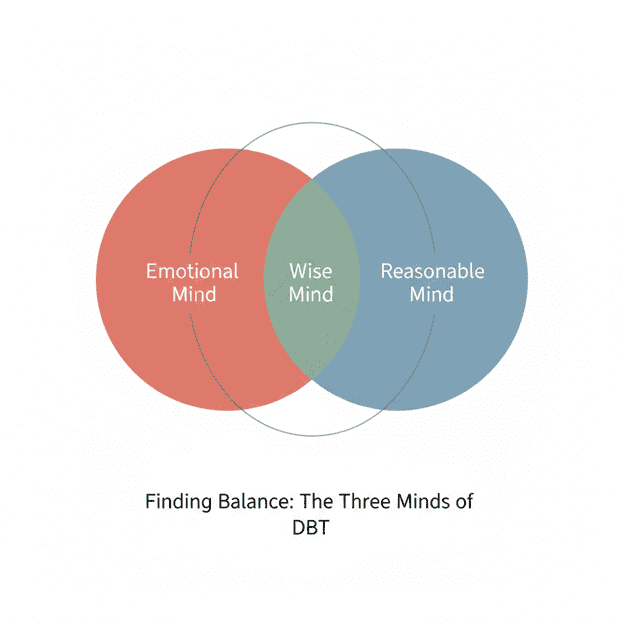
Wise Mind vs. Emotional Mind in DBT: Finding Your Balance
Do you ever feel like your emotions are in the driver’s seat, leading you to make impulsive decisions you later regret? Or perhaps you’ve experienced the opposite feeling so focused on logic and productivity that you’ve become detached from your own feelings and the people around you?
In Dialectical Behavior Therapy (DBT), these experiences are described as different states of mind. The ultimate goal of DBT is not to eliminate your logic or suppress your emotions, but to find the Middle Path. This balance is known as the Wise Mind.
By understanding the interplay between the Emotional Mind, Reasonable Mind, and Wise Mind, you can learn to regulate your reactions and make decisions that align with your true values.

The Emotional Mind: When Feelings Take the Lead
The Emotional Mind is the state where your thoughts and behaviors are controlled almost entirely by your current feelings. When you are in this state, facts and logic often take a backseat to the intensity of what you are experiencing in the moment.
Common Symptoms of the Emotional Mind:
- High Reactivity: Small triggers lead to large emotional outbursts.
- Impulsivity: Acting quickly without considering long-term consequences.
- Mood-Dependency: Your ability to complete tasks or interact with others depends entirely on how you feel at that second.
The Positive Side: Why We Need It
It is a common misconception in therapy that the Emotional Mind is bad. In reality, this state is vital for a fulfilling life. It is the source of:
- Deep Empathy: Allowing you to connect with the pain and joy of others.
- Creativity: Driving artistic expression and passion.
- Love and Devotion: Providing the heart behind our most important relationships.
The Danger Zone
While emotions give life color, an unchecked Emotional Mind can be destructive. If logic is completely ignored, it can lead to a Danger Zone characterized by:
- Self Harming Behaviors
- Substance Use
- Bridge burning in professional and personal relationships.
The goal is to acknowledge the emotion without letting it steer the ship into a storm. The Emotional Mind should guide us, but not control us completely.