
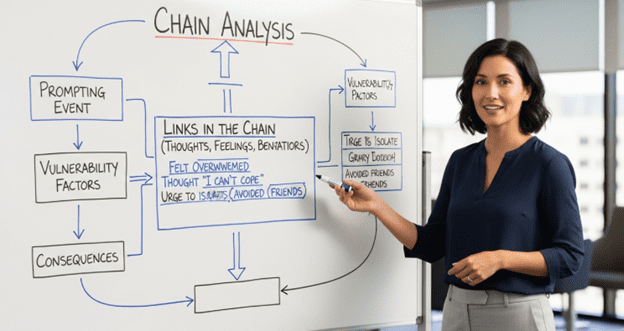
DBT Chain Analysis Example
If you’ve ever wondered why a small trigger leads to overwhelming emotions or impulsive behavior, you’re not alone. Emotional reactions rarely happen in isolation; they follow a pattern. Understanding that pattern is exactly what a DBT chain analysis example helps you do.
This guide provides a complete, structured, real-world breakdown so you can understand not just what happened but why it happened and where you can change it.
DBT Chain Analysis Example — Short Answer
A DBT chain analysis example shows how a problematic behavior develops step-by-step.
It breaks down:
vulnerability factors → triggering event → thoughts → emotions → physical sensations → behavior → consequences.
It helps identify where to intervene and apply DBT skills to prevent the behavior from repeating.
What Is Dialectical Behavior Therapy (DBT)?
Dialectical Behavior Therapy (DBT) is an evidence-based psychotherapy designed to help individuals manage intense emotions, reduce self-destructive behaviors, and improve relationships.
Developed by psychologist Marsha Linehan, DBT was originally created to treat Borderline Personality Disorder (BPD). Today, it is widely used for:
- Emotional dysregulation
- Self-harm behaviors
- Suicidal ideation
- Impulsivity
- Anxiety and mood disorders
DBT includes four core modules:
- Mindfulness – Awareness without judgment
- Distress Tolerance – Surviving crises without worsening them
- Emotion Regulation – Managing emotional intensity
- Interpersonal Effectiveness – Improving communication and boundaries
Chain analysis is one of DBT’s most powerful tools.
What Is DBT Chain Analysis?
Core Definition of DBT Chain Analysis
DBT chain analysis is a structured behavioral analysis tool used to understand cause-and-effect patterns behind problematic behaviors.
Instead of asking “Why did I do this?” it asks:
- What led up to it?
- What happened step-by-step?
- Where could I have intervened?
Its purpose is not to blame its awareness and skill-building.
Components in a DBT Chain Analysis Example
A proper DBT chain analysis example includes:
- Vulnerability factors (lack of sleep, stress, illness)
- Prompting event (the immediate trigger)
- Thoughts (interpretations of the event)
- Emotions (rated by intensity)
- Body sensations
- Urges
- Problem behavior
- Short-term consequences
- Long-term consequences
This structure makes patterns visible and patterns can be changed.
Real-Life DBT Chain Analysis Example (Detailed Breakdown)
DBT Chain Analysis Example – Scenario Overview
Case scenario:
After an argument with a partner, a person experiences a strong self-harm urge.
Now let’s break it down.
Step-by-Step DBT Chain Analysis Example
1. Vulnerability Factors
- Slept only 4 hours
- High work stress
- Skipped meals
- Already feeling insecure in the relationship
These factors lowered emotional resilience.
2. Triggering Event
Partner didn’t reply to a message for 3 hours.
3. Thoughts
- “They’re ignoring me.”
- “I don’t matter.”
- “I’m going to be abandoned.”
4. Emotions (Intensity Rated)
- Sadness – 85%
- Anger – 60%
- Fear – 75%
- Shame – 50%
5. Physical Sensations
- Tight chest
- Rapid heartbeat
- Stomach discomfort
6. Urges
- Send angry texts
- Withdraw
- Self-harm to reduce emotional pain
7. Problem Behavior
Engaged in self-harm behavior.
8. Immediate Consequences
- Temporary emotional relief
- Guilt
- Increased shame
9. Long-Term Consequences
- Relationship strain
- Reinforced harmful coping
- Lower self-esteem
Where the Chain Could Have Been Broken
This is the most powerful part of a DBT chain analysis example.
Possible intervention points:
After vulnerability factors:
- Improve sleep
- Eat regularly
- Practice emotion regulation skills
After thoughts:
- Use cognitive reframe
- Check the facts
- Ask for clarification
After emotional spike:
- Distress tolerance skill (ice water, paced breathing)
- Delay action by 20 minutes
Before behavior:
- Call a support person
- Use opposite action
- Engage in grounding exercise
Each link is an opportunity for skill insertion.
How to Do a DBT Chain Analysis Example Step-by-Step
Step 1 – Identify the Target Behavior
Be specific.
Not “I messed up.”
But: “I yelled during the argument.”
Step 2 – List Vulnerability Factors
Ask:
- Was I tired?
- Was I hungry?
- Was I already stressed?
Step 3 – Identify the Prompting Event
What happened immediately before the reaction?
Step 4 – Track the Chain Link by Link
Write:
Event → Thought → Emotion → Body → Urge → Behavior.
Be precise.
Step 5 – Add Solution Analysis
Ask:
- Where could I have acted differently?
- Which DBT skill fits here?
Step 6 – Apply DBT Skills to Break the Chain
Choose one skill:
- STOP skill
- Opposite action
- Self-soothing
- Radical acceptance
Consistency builds change.
DBT Chain Analysis Worksheet Template
Fill-in-the-Blank DBT Chain Analysis Example Template
| Section | What to Write | Example |
| Vulnerabilities | Physical/emotional weaknesses | Lack of sleep |
| Trigger | Immediate event | Partner didn’t respond |
| Thoughts | Interpretations | “I’m being ignored” |
| Emotions | Rate intensity | Sadness 80% |
| Behavior | What you did | Sent angry message |
| Consequences | Short & long term | Regret, conflict |
You can convert this into a printable worksheet for regular practice.
DBT Chain Analysis Example vs Other Behavioral Analysis Methods
| Feature | DBT Chain Analysis | CBT Thought Record | Functional Behavior Analysis |
| Focus | Behavioral sequence | Cognitive distortions | Reinforcement patterns |
| Best For | Emotional dysregulation | Anxiety/Depression | Behavioral disorders |
| Skill Integration | Yes | Limited | No |
DBT chain analysis uniquely integrates emotional regulation skills, making it ideal for high-intensity emotional reactions.
Common Mistakes in a DBT Chain Analysis Example
- Ignoring vulnerability factors
- Skipping body sensations
- Not rating emotional intensity
- Overgeneralizing thoughts
- Forgetting solution analysis
Precision creates clarity.
Benefits of Using a DBT Chain Analysis Example
- Increases emotional awareness
- Reduces impulsive behavior
- Improves distress tolerance
- Strengthens accountability
- Prevents repeated behavioral cycles
Over time, patterns become predictable and manageable.
When to Seek Professional Help
Seek support if you experience:
- Frequent self-harm urges
- Suicidal thoughts
- Severe emotional dysregulation
- Trauma-related triggers
If you are in immediate danger, contact local emergency services or a suicide prevention hotline in your country. DBT works best when guided by a trained therapist, especially in high-risk situations.
Frequently Asked Questions (FAQs)
What is a DBT chain analysis example used for?
It is used to understand the step-by-step causes of a problematic behavior and identify intervention points.
How long does a DBT chain analysis take?
Typically 10–30 minutes depending on detail and emotional complexity.
Can I do a DBT chain analysis example on my own?
Yes, but working with a therapist provides deeper insight and safety support.
Is DBT chain analysis effective for anxiety?
Yes. It helps identify anxiety triggers and behavioral reactions.
How often should I complete a DBT chain analysis?
Whenever a significant emotional reaction or problematic behavior occurs.
What is the difference between chain analysis and solution analysis?
Chain analysis examines what happened. Solution analysis identifies how to respond differently next time.
Is DBT chain analysis only for BPD?
No. It’s used for anxiety, depression, trauma, addiction, and emotional dysregulation.
Can DBT chain analysis reduce self-harm behaviors?
Yes. By identifying triggers and inserting coping skills, it reduces impulsive self-harm cycles.
Conclusion: How to Start Using a DBT Chain Analysis Example Today
A dbt chain analysis example is not just a worksheet it’s a blueprint for emotional change.
Here’s how to begin:
- Identify one recent emotional reaction.
- Break it down link by link.
- Insert one skill at the weakest point in the chain.
Print the worksheet. Practice weekly. Reflect honestly.
Change does not happen at the moment of crisis, it happens in the awareness before it. And that awareness starts with understanding your chain. At South Side DBT, we help individuals slow down, examine their behavioral patterns, and identify the emotional triggers that lead to crisis, so real change begins long before the breaking point.