

DBT Therapy Process Questions: Everything You Want to Know
Everything You Want to Know Before, During & After Your First Session
By Southside DBT | Kelly Pinnick, DBT-Linehan Board of Certification™ – Certified Clinician™
Serving Atlanta Metro Area via Telehealth
If you’ve ever thought about starting therapy or if you’ve already taken that brave first step and scheduled a session you probably have a lot of questions. That’s completely normal.
Therapy can feel mysterious, even intimidating, especially if it’s your first time. And if you’ve heard the term DBT (Dialectical Behavior Therapy) and wondered what it actually involves, you’re not alone.
This guide is designed specifically to answer the therapy process questions we hear most often at Southside DBT. We go beyond the generic to give you a real, honest look at what DBT therapy looks and feels like from your very first call to years down the road. Our goal is to make you feel prepared, not overwhelmed.
| 💡 Note | This guide is written from the DBT-specific perspective of Southside DBT. While some of these questions apply to therapy in general, many are uniquely answered through the lens of Dialectical Behavior Therapy. |
Part 1: Before You Start — Questions About Getting Ready for DBT
1. How do I know if DBT is the right therapy for me?
DBT was originally developed to treat Borderline Personality Disorder (BPD), but today it’s recognized as highly effective for a wide range of struggles including:
- Intense or rapidly shifting emotions that feel out of control
- Patterns of self-harm, suicidal thoughts, or urges to hurt yourself
- Explosive anger or difficulty managing frustration
- Unstable or chaotic relationships
- Chronic feelings of emptiness, shame, or low self-worth
- Impulsive behaviors (spending, eating, substances, risky choices)
- Anxiety, depression, or PTSD that hasn’t improved with other therapy
If you recognize yourself in two or more of those descriptions, DBT is likely a strong fit. The key question isn’t whether your diagnosis matches it’s whether you struggle to control, tolerate, or manage your emotions and the behaviors that follow.
| Kelly’s Take | Many of my clients come in having tried ‘regular’ talk therapy and feeling stuck. DBT offers something different: a structured, skills-based approach that doesn’t just explore why you feel what you feel — it teaches you what to do about it. |
2. What’s the difference between DBT and regular talk therapy?
Great question. Most people are familiar with talk therapy you meet with a therapist, discuss what’s going on, and explore your thoughts and feelings. That’s valuable, but it can feel passive.
DBT is different in some key ways:
| Traditional Talk Therapy | DBT (Dialectical Behavior Therapy) |
| Insight-focused | Insight + active skill-building |
| Open-ended exploration | Structured treatment with clear goals |
| Works through emotions verbally | Teaches tools to regulate emotions in real time |
| May not have homework | Includes skills practice between sessions |
| Less structured timeline | Treatment has defined phases and milestones |
| Therapist may not consult with peers | DBT therapists meet in consultation teams |
3. Do I need a formal diagnosis to start DBT?
No. You do not need a formal psychiatric diagnosis to work with a DBT therapist. What matters most is the pattern of your experience particularly whether emotion dysregulation is showing up in ways that interfere with your relationships, your daily functioning, or your sense of self.
During your initial session, a DBT clinician will conduct a thorough assessment to understand your history, your current struggles, and what you’re hoping to change. From there, an individualized treatment plan is built specifically for you.
4. I’ve tried therapy before and it didn’t work. Why would DBT be different?
This is one of the most common things we hear and it’s a completely valid concern.
Here’s the honest answer: if you’ve struggled primarily with emotional intensity, impulsive behavior, or unstable relationships, generic talk therapy may not have been addressing the root mechanism. DBT is specifically engineered for emotion dysregulation. It doesn’t just help you understand your patterns it gives you real, concrete tools to change them.
Additionally, DBT holds a core assumption that can feel almost radical: ‘Clients may not have caused all of their own problems, but they have to solve them anyway.’ This is both validating (your pain is real and often the result of your environment) and empowering (you have more capacity to change than you might believe).
Part 2: The First Session — What to Expect
5. What happens in the very first DBT session?
The first session is primarily an intake and assessment. Your therapist will:
- Ask about what brought you to therapy and what you’re hoping to work on
- Explore your personal history, including past trauma, relationships, and prior therapy experiences
- Ask about behaviors that are currently interfering with your quality of life
- Explain how DBT works and what treatment will involve
- Answer your questions openly and honestly
You are not expected to have everything figured out. You don’t need to arrive with a prepared speech or a list of problems. Simply showing up is the most important step.
| What NOT to worry about | You won’t be judged for anything you share. DBT therapists are trained in radical acceptance — meaning we hold space for the full truth of your experience without shame or judgment. |
6. What kinds of questions will my DBT therapist ask me?
In the first session and early treatment, your therapist will want to understand several things:
About your current struggles:
- “What’s bringing you in today? What feels most urgent?”
- “Are there any behaviors you’ve been doing or urges you’ve been having that are getting in the way of your life?”
- “How have your emotions been affecting your relationships, work, or daily functioning?”
About your emotional experience:
- “How would you describe your emotional baseline is it generally calm, or do you feel like you’re often in crisis?”
- “What does it feel like in your body when you get overwhelmed?”
- “Are there emotions you avoid feeling? Emotions that seem to take over?”
About what you want:
- “What does a life worth living look like for you?”
- “What would have to change for you to feel like therapy was successful?”
- “What have you tried before, and what did or didn’t work?”
About safety (if relevant):
- “Are you having any thoughts of hurting yourself or ending your life?”
- “Have you engaged in any self-harm recently?”
These questions about safety are asked not to alarm you, but because DBT specifically prioritizes life-threatening behaviors first. You will never be penalized or shamed for answering honestly.
7. What questions should I ask my DBT therapist?
Coming in with your own questions is encouraged. Here are some we recommend you ask:
- “Are you fully certified in DBT, or do you incorporate some DBT elements?” (There’s an important difference look for DBT-Linehan Board of Certification™.)
- “How structured is your DBT program? Will I have skills to practice at home?”
- “Do you consult with a DBT team?”
- “What does phone coaching look like in your practice?”
- “How will we know when I’m making progress?”
- “How do you handle crisis situations between sessions?”
| Why this matters | Not all therapists who say they ‘use DBT’ are actually trained in comprehensive DBT. Board Certification from the DBT-Linehan Board of Certification™ is the gold standard. Kelly at Southside DBT holds this certification. |
Part 3: Inside DBT How the Therapy Process Actually Works
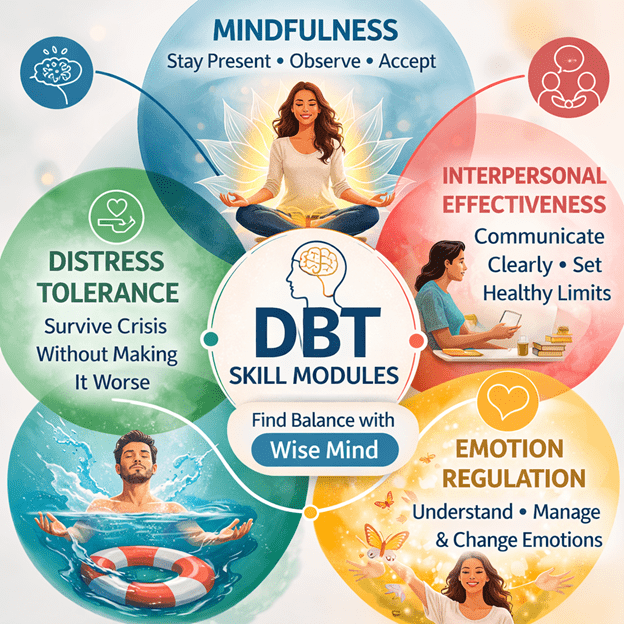
8. What are the four DBT skill modules, and what questions come up in each?
DBT treatment is organized around four core skill modules. Here’s what each one addresses and what the therapeutic conversation often looks like:
Module 1: Mindfulness
Mindfulness is the foundation of DBT. It’s about learning to observe your thoughts, feelings, and sensations without immediately reacting.
Common therapy questions in this module:
- “When you feel overwhelmed, what’s the first thing you notice a thought, a body sensation, or a feeling?”
- “Are you able to observe your emotions without being swept away by them?”
- “What does it feel like when you’re in ‘Wise Mind’ the balance between emotion and reason?”
Module 2: Distress Tolerance
This module teaches you to survive crisis moments without making things worse. It’s about getting through the unbearable without acting in ways you’ll regret.
Common therapy questions:
- “When things get really painful, what do you usually do? Does it help short-term but hurt long-term?”
- “Are there situations you’re currently in crisis about that we need to address first?”
- “What does ‘radical acceptance’ feel like when you try it? What gets in the way?”
Module 3: Emotion Regulation
Here you learn to understand, name, and change your emotional responses. This is where you start to feel less controlled by your feelings and more like you have agency over them.
Common therapy questions:
- Can you name what emotion you were feeling in that moment specifically?
- What triggered the emotion? What kept it going?
- What action urge came with that emotion, and what did you actually do?
- Are there ways to build more positive emotions into your daily life? What gets in the way?
Module 4: Interpersonal Effectiveness
This module tackles your relationships how to ask for what you need, how to say no, and how to maintain self-respect in conflict without destroying the relationship.
Common therapy questions:
- When you need something from someone, what usually stops you from asking?
- How do you feel after you say yes to something you really wanted to say no to?
- How do you balance being effective in relationships with honoring your own values?
9. What is a diary card, and how does it work in DBT sessions?
A diary card is a daily tracking tool used in DBT. Each day, you record:
- Your emotional intensity throughout the day (on a scale of 0–5)
- Any urges you had to engage in target behaviors (e.g., self-harm, substance use, impulsive actions)
- What DBT skills you used and whether they helped
- Any other relevant behaviors or events from that day
At the start of each therapy session, you and your therapist review the diary card together. This is how the session agenda gets set you work on what’s actually been happening, not what you remembered to bring up.
Think of it as a living map of your week. It keeps therapy honest, specific, and grounded in your real experience.
10. What is a behavioral chain analysis, and why does DBT use it?
A chain analysis is one of the most powerful tools in DBT. When a problematic behavior occurs anything from a blow-up argument to self-harm to a binge your therapist walks you through a step-by-step breakdown of exactly what happened:
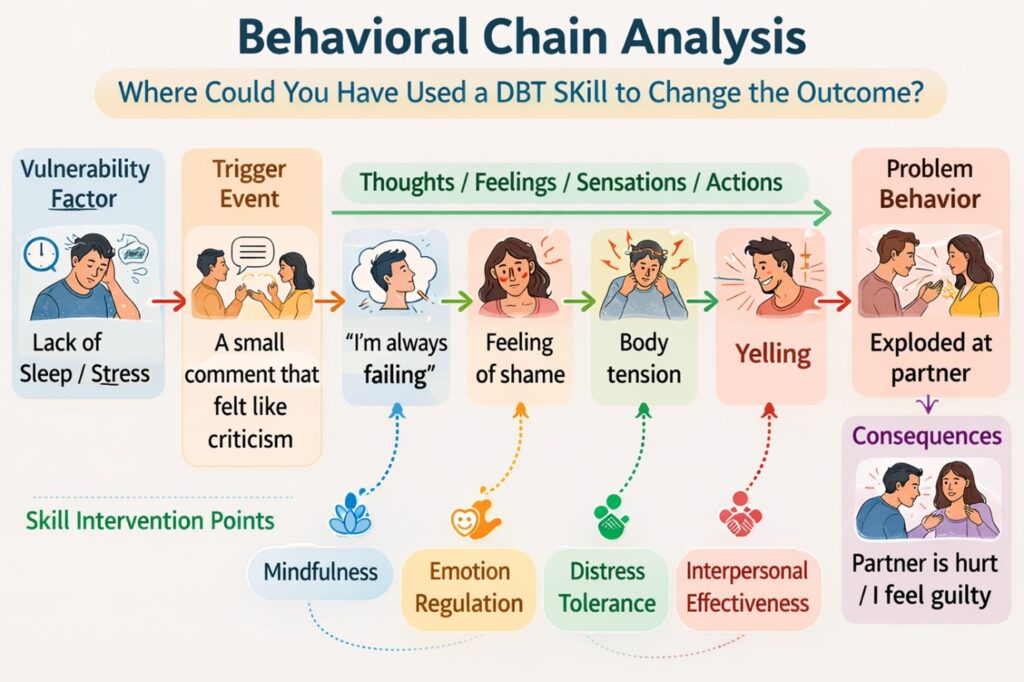
- What was the vulnerability factor? (Were you tired, sick, stressed before it began?)
- What was the triggering event?
- What thoughts, feelings, body sensations, and actions followed in sequence?
- What was the problem behavior?
- What were the consequences?
The goal isn’t to make you feel guilty it’s to find the exact links in the chain where a different DBT skill could have changed the outcome. Then, in future sessions, you build that into your response pattern.
| Real Example | A client might say, ‘I don’t know why I exploded at my partner.’ A chain analysis might reveal: poor sleep the night before → a small comment that felt like criticism → a feeling of shame → a thought of ‘I’m always failing’ → body tension → yelling. Now we know where to intervene. |
11. How long does DBT therapy typically take?
Comprehensive DBT is designed to be a minimum of one year for most clients. This is because the treatment has distinct stages and real skill-building takes time.
The general stages are:
- Stage 1 (Months 1–12+): Stabilization reducing life-threatening behaviors, therapy-interfering behaviors, and quality-of-life-interfering behaviors
- Stage 2: Processing addressing trauma, grief, or suppressed emotional pain once the client is stable
- Stage 3 & 4: Building a life increasing self-respect, connection, meaning, and joy
Some clients see significant change within months. Others work in DBT for several years. The timeline depends on your goals, your history, and how quickly you’re able to generalize new skills into your daily life.
Part 4: The Therapeutic Relationship Honest Questions People Are Afraid to Ask
12. What if I don’t like my therapist or feel like it’s not working?
This is a legitimate and important question. The therapeutic relationship is one of the strongest predictors of outcomes and DBT explicitly names the client-therapist relationship as a core component of treatment.
If something isn’t working, you are encouraged to bring it into session directly. A good DBT therapist will not become defensive. They will work with you to understand what’s happening and adjust accordingly.
It’s also worth noting: sometimes what feels like ‘this isn’t working’ is actually a signal that therapy is working that difficult material is surfacing. Your therapist can help you tell the difference.
13. What happens if I’m in crisis between sessions?
DBT is specifically designed to address this question. In comprehensive DBT, phone coaching is available between sessions for exactly this reason. You can reach out to your therapist when you’re in crisis to receive brief coaching on which skills to use in that moment.
Important: phone coaching in DBT is not a replacement for emergency services. If you are in immediate danger, always call 988 (Suicide & Crisis Lifeline) or 911.
| At Southside DBT | Phone coaching is part of the comprehensive DBT model. Kelly will discuss what this looks like in practice during your initial session. |
14. Will my therapist judge me for what I share?
No. DBT is built on a foundation of radical acceptance — the practice of accepting yourself and your experience fully, without condemnation.
In practice, this means your therapist holds a non-judgmental stance toward everything you bring into the room. You will not be told you are bad, broken, or beyond help. You will be met with warmth, directness, and genuine care.
Here is what actual clients of Southside DBT have shared:
| Client Testimonial | “Kelly has never made me feel judged. She goes above and beyond for her clients. She makes learning DBT easy and relatable.” |
| Client Testimonial | “She listens to me, encourages me, never judges, and has helped me become a better person all around. In the last 3 years I have experienced tremendous growth.” |
15. Do I have to talk about my past or childhood trauma?
Not right away and possibly not at all in the early stage of treatment.
DBT Stage 1 focuses on your present behavior and building stabilization skills. Deep trauma processing typically happens in Stage 2, after you have enough skills to handle the emotional intensity that trauma work can bring up.
This sequencing is intentional. Going into trauma prematurely can destabilize clients who don’t yet have strong coping skills. DBT protects you by building your foundation first.
Part 5: Practical Questions Logistics, Telehealth & Costs
16. How does telehealth DBT work? Is it as effective as in-person?
Telehealth DBT has become increasingly common and research supports that it is equally effective for most clients when compared to in-person delivery.
At Southside DBT, all sessions are conducted via telehealth, which means you can access evidence-based DBT care from anywhere in Georgia, including Atlanta, Macon, Columbus, and Savannah.
Telehealth also offers practical advantages:
- No commute time or travel anxiety
- Sessions from your own home, which some clients find more comfortable
- Easier to maintain consistency in your schedule
- Access to specialized care regardless of your location within Georgia
The only real requirement for telehealth to work is a private, stable-enough space where you can speak freely.
17. What does DBT cost? Does insurance cover it?
At Southside DBT, sessions are $150 per session for self-pay clients. Insurance is also accepted through the following providers:
- Aetna
- Anthem Blue Cross and Blue Shield of Georgia
- Cigna
- United Healthcare (Optum)
Billing is managed through Headway, which handles all insurance and payment processing. If your insurance is not listed, you may still be eligible for out-of-network (OON) reimbursement using a superbill.
18. How do I know I’m making progress in DBT?
Progress in DBT is measurable one of the things that makes it distinct from open-ended therapy. Signs you’re making real progress include:
- Fewer and less intense crisis episodes
- Increased ability to name and describe your emotions accurately
- Using skills before or during distress, not just after
- Fewer behaviors you regret
- Improved relationships or communication
- Reduced self-harm urges or acts
- Feeling more like yourself more like the person you want to be
Your diary card provides concrete, ongoing evidence of this progress. Many clients find it deeply motivating to look back at where they started compared to where they are now.
Part 6: DBT-Specific Questions Your Therapist Wants You to Ask
19. What is ‘Wise Mind,’ and how do I access it?
Wise Mind is one of the foundational concepts in DBT mindfulness. Imagine a Venn diagram:
- Emotion Mind: all feelings, no logic reactive, driven purely by how you feel
- Reasonable Mind: all logic, no feelings cold, analytical, dismissive of emotion
- Wise Mind: the overlap the place where you can feel your emotions AND think clearly at the same time
Accessing Wise Mind is a skill you practice. Your therapist may ask: ‘What does Wise Mind say about this situation?’ When you’re in emotion mind, that question can feel infuriating. When you’ve practiced it, it becomes a compass.
20. What is ‘Radical Acceptance,’ and does it mean giving up?
No and this is one of the most misunderstood concepts in DBT.
Radical Acceptance doesn’t mean you approve of what happened or that you give up trying to change things. It means you stop fighting reality stop adding suffering on top of pain by wishing things were different than they are.
The DBT formula: Pain + Non-Acceptance = Suffering. Pain + Acceptance = just pain.
Pain is unavoidable. The extra layer of suffering that comes from raging against what is that’s optional.
| In Session | Your therapist might ask: ‘Is this a situation where you can change something, or is this something you need to practice accepting?’ That question alone can redirect enormous energy. |
21. What’s the difference between ‘validating’ feelings and ‘enabling’ bad behavior?
This question comes up often especially for clients who grew up in environments where their emotions were dismissed, minimized, or punished.
In DBT, validation means communicating that your feelings make sense given your history and current experience. It does not mean all behaviors are acceptable or that you can do whatever your feelings push you toward.
DBT holds both things simultaneously: Your feelings are valid AND you can choose behaviors that align with your goals and values. This is the ‘dialectical’ part holding two true things at once, even when they seem to conflict.

Ready to Start? What Happens Next
If you’ve read this far, you’re already doing something most people don’t do before starting therapy: asking real questions.
At Southside DBT, we believe an informed client is an empowered client. The more you understand about the therapy process, the more you can participate actively in your own healing.
Kelly Pinnick is a DBT-Linehan Board of Certification™ Certified Clinician™ serving clients throughout Georgia via telehealth. She has been practicing DBT since 2015 and uses the skills herself every day.
| 📞 Call or Text (770) 880-2538 | ✉ Email kelly@southsidedbt.com |
Serving: Atlanta, GA · Macon, GA · Columbus, GA · Savannah, GA
© 2026 Southside DBT. All Rights Reserved.