
Emotional Numbness
What It Really Is, Why It Happens, and How to Feel Your Life Again
By Kelly Pinnick, DBT-Linehan Board of Certification, Certified Clinician | Southside DBT | Telehealth across Georgia
There is a particular kind of suffering that does not announce itself with tears or rage or visible distress. It arrives quietly. You stop looking forward to things. You find yourself watching other people laugh and feel nothing. Someone you love tells you something wonderful and you produce the right expression without feeling anything underneath it. You are present but absent. Alive but not quite living.
This is emotional numbness. And while it does not look dramatic from the outside, it is one of the most disorienting and painful experiences a person can have, specifically because the absence of feeling is itself a form of suffering.
The Cleveland Clinic describes emotional numbness as your brain pressing the pause button. That is a useful starting point, but it does not go far enough. This guide goes further. It explains what emotional numbness actually is at the neurological and psychological level, the multiple distinct mechanisms that cause it, how it connects to emotion dysregulation and the conditions DBT was designed to treat, how to tell the difference between protective numbness, clinical depression, and dissociation, and what specific, concrete steps, including DBT skills, can actually move you back toward your emotional life.
| Who This Is For | Anyone experiencing emotional numbness or emotional blunting, whether it is new, long-standing, connected to a clear cause, or unexplained. And anyone who wants more than a brief overview. |
Part 1: What Emotional Numbness Actually Is
Emotional numbness, also called emotional blunting or affective blunting, is not a single thing. It is a description of a symptom that can have several distinct underlying mechanisms, each of which requires a different understanding and a different approach.
What all forms of emotional numbness share is this: a reduction or absence of emotional responsiveness that is noticeable and that differs from the person’s baseline. It is not introversion, quietness, or emotional restraint. It is the experience of emotions being absent, muffled, or inaccessible in ways that feel involuntary.
The Three Faces of Emotional Numbness
Understanding which type of numbness you are experiencing matters because they respond to different interventions.
| Type | What It Feels Like | What Is Happening Underneath |
| Protective Numbness | Emotions feel distant or muted following a traumatic or overwhelming event. Numbness as shock buffer. | Nervous system has activated the freeze response to prevent emotional overwhelm. Temporary and often self-resolving. |
| Chronic Suppressive Numbness | Emotions feel flat, inaccessible, or absent most of the time. Long-standing. May not have a clear onset. | Learned suppression from childhood environment, repeated trauma, or chronic dysregulation. The emotional system has been trained to stay offline. |
| Dissociative Numbness | Feeling detached from yourself, your surroundings, or reality. A sense of watching your own life from outside. May feel dreamlike or unreal. | Dissociation as a trauma response. The mind has disconnected from present experience to escape overwhelming distress. Often requires specific trauma-focused treatment. |
All three types are real. All three deserve to be taken seriously. And all three have different implications for treatment.
Part 2: The Neuroscience of Feeling Nothing
Emotional numbness is not a character flaw, a weakness, or a sign that you do not care. It is a neurological event. Understanding the brain mechanisms behind it changes the relationship to it.
The Freeze Response and the Shutdown State
The human nervous system has three primary responses to perceived threat: fight, flight, and freeze. Most people are familiar with fight and flight. The freeze response is less discussed but equally significant.
Freeze is not passivity. It is the nervous system’s emergency shutdown protocol: a state of immobilization activated when a threat is assessed as inescapable or overwhelming. During freeze, the dorsal vagal pathway of the autonomic nervous system dominates, reducing heart rate, suppressing metabolic activity, and dampening emotional processing. The result is the characteristic flatness, disconnection, and absence of feeling that defines emotional numbness.
In acute situations, this response is adaptive. It conserves resources, reduces pain, and allows the organism to survive an overwhelming experience. The problem arises when the freeze response becomes chronic: when the nervous system remains in low-level shutdown because it has learned that the emotional world is too dangerous to be online for.
The Role of the Prefrontal Cortex
Emotional processing involves a dynamic relationship between the amygdala, which generates emotional responses, and the prefrontal cortex, which regulates, interprets, and integrates them. When this relationship is disrupted, emotional experience becomes distorted.
In some forms of numbness, particularly those associated with trauma, the prefrontal cortex becomes overactive in its inhibitory function: it suppresses emotional signals before they can be consciously experienced. The person is technically generating emotional responses at the amygdala level, but those responses are being blocked before they reach conscious awareness.
This is neurologically distinct from not having emotions. The emotions are present. They are simply being intercepted before the person can feel them. This distinction is clinically important because it points toward approaches that work with the body and with awareness, not just cognitive reframing.
Cortisol, Chronic Stress, and Emotional Blunting
Chronic stress produces sustained elevated cortisol levels. Over time, prolonged cortisol exposure has been shown to reduce the density of receptors in emotional processing areas of the brain, reducing their sensitivity and responsiveness. The brain essentially turns down the volume on its emotional systems as a protective measure against being continuously overwhelmed.
This cortisol-related blunting is one reason why people who have experienced sustained periods of chronic stress, prolonged caregiving, long-term overwork, or ongoing relational conflict often describe a gradual dulling of emotional responsiveness that they cannot attribute to any single event.
| Kelly’s Perspective | In my clinical work I regularly meet people who describe emotional numbness and immediately follow it with an apology. They say things like I know I should be feeling more about this or I feel like something is wrong with me because I cannot cry. The first thing I want them to understand is that numbness is information, not failure. Their system is telling them something. We just need to learn to listen to what. |
Part 3: The Causes of Emotional Numbness — A Detailed Breakdown
Cleveland Clinic identifies nine causes of emotional numbness. We cover all of them here, and go considerably deeper on the ones most relevant to the people who come to Southside DBT.
Trauma and Post-Traumatic Stress
Trauma is one of the most common causes of emotional numbness, and the relationship is direct. When an experience exceeds the nervous system’s capacity to process it in the moment, the system responds with dissociation and shutdown. This is protective in the acute phase. It becomes problematic when it persists.
In PTSD, emotional numbness is one of the negative symptom clusters alongside intrusive symptoms and hyperarousal. People with PTSD often describe a profound disconnection from their own emotional life: being unable to feel love or closeness with people they know they care about, losing interest in activities that previously brought them joy, and experiencing a pervasive sense of a foreshortened future.
The numbness in PTSD is not absence of emotion. It is containment of emotion that cannot yet be safely processed. And it coexists, often uneasily, with the explosive emotional reactivity that characterizes the hyperarousal symptoms. This combination, profound flatness interspersed with overwhelming emotional floods, is one of the most disorienting aspects of post-traumatic experience.
Chronic Emotional Suppression and Invalidating Environments
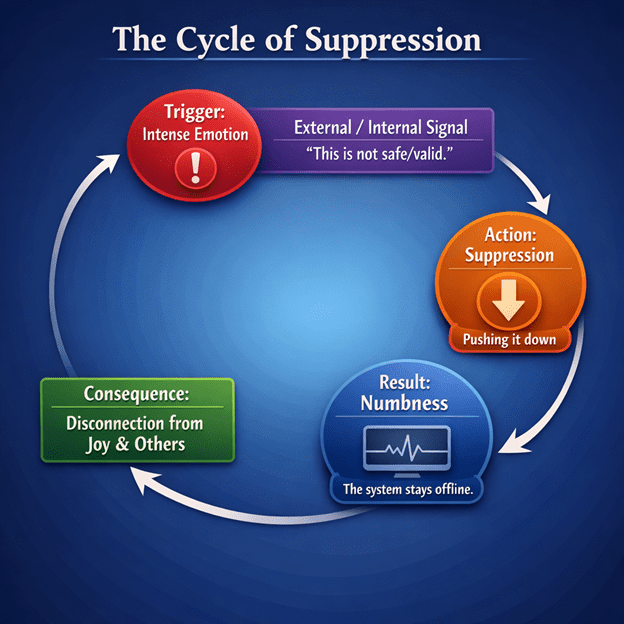
For many people, emotional numbness did not begin with a single traumatic event. It developed gradually, in childhood or adolescence, in response to an environment that communicated that emotions were not welcome, not safe, or not valid.
This is what DBT calls an invalidating environment: a context in which emotional expression was consistently met with dismissal, punishment, ridicule, or neglect. Children who grow up in invalidating environments do not learn to process emotions. They learn to suppress them. And what is suppressed long enough eventually becomes inaccessible.
This pattern is particularly relevant in DBT because it is one of the primary developmental pathways to the emotion dysregulation that DBT treats. The person who comes to therapy numb has often spent years and in many cases decades successfully learning not to feel. The work is not to force feeling but to gradually create the safety and skills that allow the emotional system to come back online.
Depression
Emotional numbness and depression are frequently conflated, and while they overlap significantly, they are not identical. Understanding the relationship between them matters because treatment differs.
In depression, emotional numbness typically presents as anhedonia: the loss of pleasure or interest in activities and relationships that previously were meaningful. This is not simply feeling sad. It is feeling nothing, or feeling a pervasive flatness that is itself distressing.
What distinguishes depression from other forms of numbness is the constellation of symptoms it travels with: disrupted sleep, reduced energy, cognitive changes, appetite changes, and a persistent negative view of self, world, and future. Numbness in depression is one symptom within a broader clinical picture rather than the primary phenomenon.
Anxiety and Emotional Overload
It seems paradoxical that anxiety, a state of heightened emotional arousal, can produce emotional numbness. But the mechanism is straightforward. When anxiety is sustained and severe, the nervous system eventually exhausts its capacity for sustained arousal and shifts into a shutdown state. Numbness following intense or chronic anxiety is the nervous system’s version of a circuit breaker tripping.
Additionally, some people experiencing anxiety have learned to cut off emotional awareness because emotions themselves trigger anxiety. The awareness that they are afraid becomes a trigger for more fear. Disconnecting from emotional awareness is an attempt to avoid that loop.
Medication-Induced Emotional Blunting
This is one of the most clinically important and underaddressed causes of emotional numbness, and it deserves significantly more attention than a single line. A substantial proportion of people taking SSRIs and SNRIs for depression or anxiety experience emotional blunting as a side effect, and this blunting is often not discussed adequately by prescribing clinicians.
Medication-induced blunting can present as reduced intensity of both negative and positive emotions, decreased motivation, diminished sense of connection to others, reduced libido, and a general sense of emotional flatness. Research published in peer-reviewed journals has found that this side effect affects a significant minority of SSRI users and is associated with treatment discontinuation.
The clinical complexity is real: the medication may be effectively reducing the target symptoms of depression or anxiety while simultaneously producing numbness that significantly affects quality of life. This is not a simple problem with a simple solution. The appropriate response is an honest conversation with your prescribing clinician about what you are experiencing, not unilateral medication discontinuation.
If you are experiencing emotional blunting you believe is related to medication, tell your prescriber specifically and describe what you are noticing. Dosage adjustment, medication switching, or augmentation strategies may all be appropriate considerations.
Substance Use
Substances that are used to manage emotional pain, including alcohol, cannabis, opioids, and others, work precisely because they blunt emotional responsiveness. The relief they provide is real. The cost is also real.
With regular use, the brain adjusts its baseline emotional sensitivity to account for the substance’s dampening effect. When the substance is not present, the emotional system is not just unsuppressed but heightened in its distress. This is one mechanism of addiction: the substance is no longer providing pleasure but is preventing the unbearable rebound distress of its absence.
The emotional numbness produced by substance use is often difficult to distinguish from underlying depression or trauma numbness, because all three may be present simultaneously. Effective treatment requires addressing all of them, typically in a coordinated way.
Burnout and Chronic Overload
Burnout produces emotional numbness through a different pathway than trauma: not through a single overwhelming event but through the gradual depletion of emotional and physiological resources. The person who has been giving beyond their capacity for too long eventually arrives at a state where there is simply nothing left to feel with.
Burnout-related numbness is often accompanied by profound fatigue, depersonalization in the sense of detachment from one’s work and roles, and a reduced sense of accomplishment or meaning. It is particularly common in caregiving professions, in people managing chronic illness of their own or a family member’s, and in people in ongoing high-demand relational situations.
Dissociative Disorders
In dissociative disorders including dissociative identity disorder and depersonalization-derealization disorder, emotional numbness is part of a more pervasive disruption of the continuity of self and experience. These conditions require specialist treatment and are beyond the scope of this guide to address comprehensively. If you experience chronic and significant derealization or depersonalization, evaluation by a clinician experienced in dissociative conditions is important.
Part 4: The Connection Between Emotional Numbness and Emotion Dysregulation
This is the section that most resources skip entirely, and it is particularly important for anyone coming to this guide through an interest in DBT.
Emotional numbness and emotional dysregulation are not opposites. They are two expressions of the same underlying problem: a nervous system that has not developed the capacity to regulate emotional experience within a manageable range.
The Dysregulation Spectrum
DBT was built on a biosocial theory of emotion dysregulation that describes emotional experience as existing on a spectrum. At one end is the state of being emotionally flooded: overwhelmed by intense emotions that cannot be modulated or contained. At the other end is the state of being emotionally shut down: unable to access or feel emotions that are present but blocked.
Many people who come to DBT oscillate between these two states. They move from overwhelming emotional floods to stretches of profound numbness, sometimes within the same day. This cycle is not random. The numbness is often a response to the flooding: the nervous system shutting down to prevent being overwhelmed again. And the flooding can be a response to the numbness: emotions breaking through after prolonged suppression.
| Emotional numbness is often not the absence of emotion. It is emotion that has been pushed underground. DBT works at both ends of the spectrum: reducing flood states while also gradually restoring access to the emotional range that has been suppressed. |
Why Numbness Can Feel Safer Than Feeling
For people with histories of emotional pain, trauma, or invalidating environments, emotional numbness is not arbitrary. It is learned. And what is learned was learned because it worked.
If every time you allowed yourself to feel, the feeling was overwhelming, uncontrollable, or followed by consequences, the rational adaptive response is to stop allowing yourself to feel. The problem is that this solution to the problem of emotional intensity creates its own problems: disconnection from relationships, loss of access to joy and meaning, and a functional impairment that pervades every area of life.
DBT addresses this directly. The approach does not force emotional access before the skills to manage emotional experience are in place. It builds the regulatory capacity first, so that when emotions begin to emerge, they can be experienced without overwhelming the person. The sequence matters: skills before exposure to what has been suppressed.
Numbness as a Therapy-Interfering Behavior
In DBT, therapy-interfering behaviors are any behaviors that get in the way of the treatment working. Emotional numbness can function as a therapy-interfering behavior not because the person is choosing to be numb but because the numbing response activates in session, preventing the therapeutic work from penetrating.
Clients who dissociate in session, who go flat when asked to engage with emotional material, or who consistently describe their experience in detached, intellectualized terms may be experiencing exactly this. The DBT therapist works directly with this pattern rather than around it, helping the client develop the awareness and skills to remain emotionally present in session in a way that is tolerable rather than overwhelming.
Part 5: A Self-Assessment — Are You Experiencing Emotional Numbness?
The following questions are not a diagnostic tool. They are a reflection aid. Answer honestly based on your experience over the past two to four weeks.
| Experience | Sometimes | Often / Always |
| I feel emotionally flat or empty most of the time | Yes | |
| I have difficulty feeling happy or excited even when good things happen | Yes | |
| I feel disconnected from people I care about | Yes | |
| Things I used to enjoy no longer interest me | Yes | |
| I feel like I am watching my life happen rather than living it | Yes | |
| I go through the motions without feeling present in what I am doing | Yes | |
| Other people seem more emotionally responsive than I do in situations | Yes | |
| I feel detached from my own body or surroundings at times | Yes | |
| I cannot cry or feel grief even when I believe I should | Yes | |
| I feel nothing when I think about the future | Yes | |
| I use substances, distraction, or busyness to avoid quiet moments | Yes | |
| I find it hard to remember the last time I felt genuinely moved or touched | Yes |
If you answered Often or Always to three or more of these items, emotional numbness is likely playing a meaningful role in your current experience and is worth addressing with professional support.
If you answered Often or Always to seven or more, the numbness is significantly affecting your quality of life and seeking evaluation and support is strongly recommended.
Part 6: The Connection Between Emotional Numbness and Self-Harm
This section addresses a topic that most resources on emotional numbness avoid entirely. It is included here because avoiding it does not protect anyone. It leaves the people who most need this information without it.
One of the functions of self-harm that is described consistently by people who engage in it is the use of physical sensation to break through emotional numbness. For someone who has been feeling profoundly flat and disconnected, the intense physical sensation of self-harm can feel like the only way to feel anything at all. The pain provides proof of existence, evidence of being alive, when everything else feels distant and unreal.
This function does not make self-harm a reasonable coping strategy. It makes it an understandable one, which is a different thing. Understanding the function, specifically that numbness is being used as a reason to self-harm, is clinically essential because it points toward what the actual treatment target is.
DBT addresses both the self-harm behavior and the numbness that drives it. The skills for reducing numbness and building emotional access that are covered in Part 8 are directly relevant to reducing the self-harm that numbness can produce. Treating numbness is, in many cases, treating self-harm at its root.
| If you are engaging in self-harm or experiencing thoughts of harming yourself, please reach out for support. Contact your therapist, call or text 988, or text HELLO to 741741. You do not have to manage this alone. |
Part 7: How Emotional Numbness Affects Relationships
Emotional numbness does not exist in isolation. It reverberates through every significant relationship in a person’s life, and the relational consequences of numbness are often what finally bring someone to seek help.
The Invisible Distance
Partners, family members, and close friends of someone experiencing chronic emotional numbness often describe a specific kind of pain: the sense of being physically present with someone who is emotionally unreachable. This is different from conflict or misunderstanding. It is the experience of reaching for someone who is there but not there.
People who love someone experiencing numbness often begin to interpret the flatness personally. They conclude that the numb person does not care, does not love them, or is deliberately withdrawing. This interpretation, while understandable, is usually incorrect. The person experiencing numbness typically does care. They simply cannot access or express that caring in ways that are emotionally registering for the people around them.
The Shame of Not Feeling
Many people experiencing emotional numbness carry significant shame about it. They feel they should be able to feel more, that their inability to respond emotionally to things that matter means something is fundamentally broken in them.
This shame is particularly acute around milestones: a birth, a death, a significant achievement, a moment that everyone else experiences as emotionally meaningful. Being unable to feel the expected emotion in the expected way produces a secondary layer of distress that compounds the numbness itself.
One of the most important things a therapist can offer to someone experiencing emotional numbness is the explicit statement that the numbness is not a character deficit. It is a response. It has a cause. And it can change.
Numbness and the Therapeutic Relationship
For people whose numbness is long-standing and connected to relational histories of invalidation or trauma, the therapeutic relationship itself is often where the thawing begins. A consistent experience of being genuinely met, accepted, and not overwhelmed in a relationship can gradually teach the nervous system that emotional presence is safe.
This is not a rapid process and it is not linear. There will be sessions that feel flat. There will be moments where the client goes numb in response to therapeutic material. A skilled DBT therapist works with these moments rather than past them, using them as data about the pattern and opportunities to practice staying present.
Part 8: DBT Skills Specifically for Emotional Numbness
The following skills are drawn from the DBT model and adapted specifically for the experience of emotional numbness. They are not about forcing emotions. They are about creating the conditions in which emotions can safely surface.
| DBT Skill: Mindfulness of Current Emotion |
| Why it helps with numbness: Numbness often involves the prefrontal cortex blocking emotional signals before they reach conscious awareness. Mindfulness of current emotion is a practice of tuning in to what is present in the body and the mind without immediately suppressing it. Even in the presence of numbness, there is usually something. A faint quality. A slight tension. A subtle preference or aversion. Mindfulness makes the faint audible. |
| How to use it: Set aside five minutes. Sit quietly. Ask yourself: if there were an emotion present right now, even a very faint one, what would it be? Do not force an answer. Simply stay with the question. Notice any physical sensation in your chest, throat, or stomach. Whatever you find, name it without judgment. Even naming nothing with awareness is a mindfulness practice. |
| DBT Skill: PLEASE Skills (Physical Illness, Eating, Avoiding substances, Sleep, Exercise) |
| Why it helps with numbness: Emotional numbness is significantly worsened by physical dysregulation. Poor sleep, irregular eating, sedentary behavior, and substance use all maintain the neurological conditions that support numbness. The PLEASE skills address the physiological substrate of emotional responsiveness. A regulated body is a precondition for emotional access. |
| How to use it: Identify which of the five PLEASE areas is most disrupted in your current life. Prioritize one concrete change in that area this week. Sleep is often the highest-leverage starting point: even one additional hour of consistent sleep has measurable effects on emotional processing and responsiveness within a few days. |
| DBT Skill: Opposite Action for Numbness |
| Why it helps with numbness: Numbness drives withdrawal: from people, activities, and experiences that might produce emotion. Withdrawal maintains numbness. Opposite action means deliberately engaging with activities and relationships despite the absence of felt motivation, because engagement gradually rebuilds the emotional pathways that numbness has suppressed. |
| How to use it: Choose one activity that used to bring you pleasure or meaning, even if you currently feel nothing about it. Do it for twenty minutes. Do not assess how you feel during it. Repeat three to five times over a week. The goal is not to produce a feeling on the first attempt. It is to begin the behavioral re-engagement that precedes emotional re-engagement. Emotion often follows action in recovery from numbness, not the other way around. |
| DBT Skill: Body Scan for Emotional Access |
| Why it helps with numbness: When emotional experience is blocked from conscious awareness, it is often still present in the body as tension, weight, temperature, or physical sensation. The body scan is a way of listening to emotional information through a different channel when the direct channel is blocked. |
| How to use it: Lie or sit comfortably. Bring attention slowly from your feet to your head, spending thirty seconds on each body region. For each area, simply notice what is there without trying to change it. Jaw tension. Tightness in the chest. Heaviness in the limbs. When you find a sensation, ask gently: if this sensation had a name, an emotion name, what might it be? You may find sadness in your chest before you can find it in your mind. |
| DBT Skill: Radical Acceptance of Numbness |
| Why it helps with numbness: Fighting numbness often reinforces it. The distress of being unable to feel produces more shutdown. Radical acceptance applied to emotional numbness means accepting that you are numb right now, without adding a layer of shame or self-criticism on top of it. This acceptance paradoxically creates more space for emotional experience to emerge than resistance does. |
| How to use it: When you notice numbness, instead of trying to force feeling or criticizing yourself for being numb, try saying internally: I am numb right now. This makes sense given what I have been through. This will not be permanent. I do not have to fix it in this moment. The combination of naming and self-compassion reduces the secondary suppression that shame produces. |
| DBT Skill: Accumulating Positive Experiences |
| Why it helps with numbness: Long-term numbness gradually depletes the stock of positive emotional memories and anticipated experiences that support emotional responsiveness. Deliberately building positive experiences, even small ones, gradually rebuilds the emotional landscape that numbness has flattened. |
| How to use it: Make a concrete list of ten activities that have historically produced any positive feeling, however mild. Schedule one per day for the next week. Keep the activities brief and achievable. Do not evaluate them during or immediately after. Over two to four weeks, notice whether the texture of daily experience begins to shift at all. Small positive inputs accumulate over time into a measurable change in baseline emotional tone. |
Part 9: Treatment for Emotional Numbness — What Actually Works
Treatment for emotional numbness depends substantially on what is causing it. Here is what the evidence supports for the most common presentations.
When Numbness Is Connected to Trauma
Trauma-related numbness requires trauma-focused treatment. DBT Stage 2, once a sufficient skills foundation has been built in Stage 1, directly addresses the processed and unprocessed trauma that underlies chronic numbness. EMDR is also well-supported for trauma-related numbness and can be combined with DBT work in some cases.
The critical principle is sequencing: building enough regulatory capacity before approaching the traumatic material that the approach does not produce re-traumatization. This is why attempting to address trauma-related numbness through emotional catharsis or intensive trauma work before skills are established can backfire.
When Numbness Is Connected to Depression
Numbness as an expression of depression responds to the full range of evidence-based depression treatments, including behavioral activation, CBT, DBT, and where appropriate, antidepressant medication. It is worth noting the potential irony: for some people, antidepressants that reduce depression may simultaneously produce or worsen emotional blunting, requiring careful clinical monitoring and adjustment.
When Numbness Is Connected to Chronic Suppression
Numbness rooted in longstanding learned suppression, particularly from invalidating childhood environments, typically requires longer-term work. The approach must be gradual: creating safety in the therapeutic relationship, building skills for tolerating emotion before attempting to access it, and working at the pace of the client’s nervous system rather than a predetermined timeline.
DBT is particularly well suited for this presentation because its biosocial model directly acknowledges and validates how emotional suppression develops in response to invalidating environments. The client is not told their suppression is wrong. They are given the skills and the relationship in which something different becomes possible.
When Numbness Is Medication-Related
Speak with your prescribing clinician. Describe specifically what you are experiencing and when it began in relation to medication changes. Dosage adjustment, medication substitution, or augmentation are all clinical options that your prescriber can evaluate. Do not stop psychiatric medication without medical guidance.
The Role of the Body in Recovery from Numbness
Recovery from emotional numbness is rarely purely cognitive or purely verbal. Because numbness is grounded in the body’s regulatory systems, treatment that works with the body directly is often necessary. This includes somatic approaches, movement, mindfulness practices that attend to physical sensation, and the physiological regulation work embedded in DBT’s PLEASE skills.
Many clients describe the beginning of recovery from numbness not as a sudden return of emotion but as a gradual warming: a small increase in emotional texture, a moment of being moved by something, a hint of longing or curiosity or sadness that feels real rather than performed. These small moments are significant. They are evidence of the emotional system coming back online.
Part 10: What Recovery from Emotional Numbness Looks Like
Recovery from emotional numbness is not a single event. It is a gradual process of increasing emotional texture, range, and presence. And it is worth describing honestly, because the expectation of a dramatic emotional awakening can make the actual, quieter process feel insufficient.
The Thawing Process
The most accurate metaphor for recovery from emotional numbness is thawing rather than awakening. It is gradual. The first signs are often mild: a moment of unexpectedly being moved by music, a flicker of genuine interest in something, a moment of warmth in a relationship that had felt flat.
These early signs often come with their own complexity. As emotional access increases, so does access to difficult emotions that were suppressed alongside the pleasant ones. Many clients find that the early stages of emotional thawing involve more sadness and grief than joy. This can feel discouraging. It is actually evidence of progress: the emotional system is coming back online, and what it has to process first is often what has been waiting longest.
The Importance of Not Rushing
One of the most common mistakes in addressing emotional numbness is trying to force emotional experience before the regulatory capacity to handle it is present. Pushing too hard, too fast, using intensive emotional exposure or catharsis techniques before stabilization is in place, can produce flooding rather than thawing, and can paradoxically reinforce the nervous system’s reason for staying shut down.
The sequence that produces durable recovery is: stabilization first, skills building second, gradual emotional re-engagement third, and deeper processing of suppressed material when the foundation is solid. This is the sequence that DBT is structured around.
| From Our Clients | I have learned to feel emotions that I thought were impossible to feel. I am forever grateful for all the things Kelly has done to help me. This is not just about learning to manage emotions. It is about learning that having emotions is survivable. |
When to Seek Help
Emotional numbness that is occasional, clearly tied to a specific stressor, and resolving on its own is part of normal human experience. It does not necessarily require professional intervention.
Emotional numbness that is persistent, pervasive, affecting your relationships and quality of life, or connected to trauma, depression, or significant impairment deserves professional support. Specifically, seek help when:
- Numbness has been present for more than a few weeks without a clear, resolving stressor
- It is affecting your relationships, work, or sense of purpose and meaning
- It is connected to depression, trauma, PTSD, or significant anxiety
- You are using substances or self-harm to manage the numbness or to feel something
- You feel like you are existing rather than living
- You have lost access to joy, connection, or meaning that was previously present in your life
Emotional numbness is treatable. The emotional life that feels inaccessible is not gone. It is waiting, behind a wall that was built for reasons that once made sense. With the right support and the right tools, that wall can come down at a pace that is manageable rather than overwhelming.
You deserve to feel your life. That is not a small thing. And it is possible.
| Experiencing Emotional Numbness? Southside DBT provides evidence-based DBT treatment for emotion dysregulation, trauma, depression, and anxiety via telehealth across Georgia. Kelly Pinnick | DBT-Linehan Board of Certification, Certified Clinician (770) 880-2538 | kelly@southsidedbt.com Serving Atlanta | Macon | Columbus | Savannah | All of Georgia via Telehealth |
Crisis Resources: 988 Suicide and Crisis Lifeline: Call or Text 988 | Crisis Text Line: Text HELLO to 741741