What Is Emotional Invalidation?
A Complete Guide to Types, Impacts, Linehan’s 6 Levels of Validation, and How to Heal
By Kelly Pinnick, DBT-Linehan Board of Certification, Certified Clinician | Southside DBT | Telehealth across Georgia
You tell someone you are hurt by something they said. They tell you you are being too sensitive.
You share that you are anxious about a situation. They tell you there is nothing to worry about.
You cry and someone says: you should not cry over something like this.
These moments are so common that most people have experienced hundreds of them. And yet their accumulated effect, particularly when they occur in early childhood or in the most important relationships of adulthood, can be profound. Emotional invalidation is not just rudeness. It is a communication, repeated over time, that tells a person: your inner experience is wrong. And when a person receives that message often enough, they begin to believe it.
This guide goes substantially deeper than most articles on this topic. It covers what emotional invalidation actually is, its seven distinct types, the neuroscience of why being invalidated feels the way it does, Marsha Linehan’s six levels of validation from DBT which provide the most clinically rigorous framework for understanding validation that exists, the specific long-term effects of chronic invalidation, how invalidation shows up across different relationships, self-invalidation and how to address it, and practical tools for building validation into your own responses.
Part 1: What Emotional Invalidation Actually Is
Emotional invalidation is any communication, verbal or nonverbal, deliberate or unintentional, that signals to a person that their emotional experience is wrong, unimportant, excessive, irrational, or unwelcome.
Validation, its opposite, is the acknowledgment that a person’s feelings, thoughts, and experiences make sense given who they are and what they have been through. Validation does not require agreement. You can validate someone’s experience of feeling hurt without agreeing that you hurt them. You can validate someone’s fear without agreeing that the feared outcome is likely. Validation says: your experience is real. It does not say: your interpretation is correct.
This distinction is important because invalidation is often defended on the grounds that the emotion was factually incorrect. You should not feel scared because there is nothing to be afraid of. But emotions are not factual claims about the external world. They are real internal experiences. Telling someone their emotion is wrong is like telling them their headache is wrong because you cannot see a lesion on an MRI. The experience is real regardless of your ability to locate its external cause.
| Validation does not require agreement. It requires acknowledgment. You can hold your own view of a situation and still confirm that the other person’s experience of it is real and meaningful. |
Part 2: Seven Types of Emotional Invalidation
Invalidation is not a single behavior. It takes many forms, some of which are obviously harmful and some of which are so common and socially normalized that they are rarely recognized as invalidating at all.
| Dismissing |
| What It Is: The emotion is simply denied, minimized, or declared inappropriate. Common Examples: You are overreacting. You should not feel that way. It is not a big deal. You are too sensitive. Emotional Impact: Person learns their emotions are excessive or wrong. Begins to suppress and second-guess emotional responses. |
| Diverting |
| What It Is: The emotional experience is acknowledged but immediately redirected away before it can be felt or processed. Common Examples: Changing the subject when someone expresses emotion. At least you still have X. Everything happens for a reason. Others have it worse. Emotional Impact: Person learns emotions are unwelcome and must be managed quickly. Emotional experience becomes isolated and unshared. |
| Judging |
| What It Is: The emotion is acknowledged but responded to with criticism of the person for having it. Common Examples: I cannot believe you are upset about something so minor. You are so emotional. Why do you always make everything about your feelings? Emotional Impact: Shame about having emotions. Concealment of emotional experience from others. Internal critic develops around emotional expression. |
| Interpreting |
| What It Is: The other person replaces your account of your own experience with their interpretation of what you are really feeling or meaning. Common Examples: You are not really upset about this, you are just tired. You do not actually feel that way. What you really mean is… Emotional Impact: Person begins to doubt their own perception of their internal states. Confusion about what they actually feel. Can develop into chronic self-doubt. |
| Threatening or Punishing |
| What It Is: Emotional expression is met with negative consequences, either explicit or implicit threats that expressing the emotion will result in punishment. Common Examples: Stop crying or I will give you something to cry about. If you keep being so sensitive, no one will want to be around you. Anger, withdrawal, or punishment following emotional expression. Emotional Impact: Person learns emotional expression is dangerous. Suppression becomes survival strategy. Fear of rejection associated with emotional vulnerability. |
| Positive Invalidation |
| What It Is: A form of invalidation that feels positive but still denies the experience. The person’s positive emotional experience is claimed, appropriated, or replaced. Common Examples: I know exactly how you feel. I would feel the same way. This is actually a good thing, you just cannot see it yet. Emotional Impact: Milder impact than negative forms but still communicates that the person’s specific experience is not distinct or uniquely theirs. Can feel like emotional erasure. |
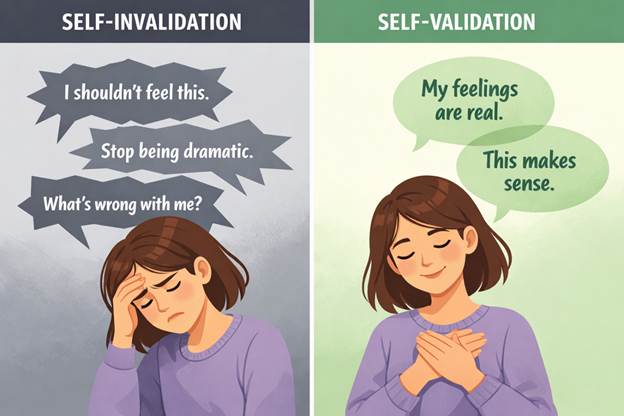
| Self-Invalidation |
| What It Is: The person applies invalidating responses to their own emotional experience, having internalized external invalidation. Common Examples: I should not feel this way. I am being ridiculous. Why am I crying? This is stupid. My feelings do not make sense. Emotional Impact: The most insidious form because it operates internally and invisibly. Produces shame, suppression, and disconnection from one’s own emotional experience. Covered in depth in Part 8. |
Part 3: The Neuroscience of Being Invalidated
Emotional invalidation does not just hurt feelings in a vague, social sense. It produces measurable neurological responses that explain why being invalidated feels as significant as it does and why chronic invalidation has the effects it has.
Social Pain and Physical Pain Share Neural Circuits
Research using neuroimaging has consistently shown that social pain, including rejection, exclusion, and the experience of having one’s feelings dismissed, activates the same neural regions as physical pain: specifically the anterior cingulate cortex and the insula. The brain does not sharply distinguish between the pain of a physical injury and the pain of being told your feelings do not matter.
This is why emotional invalidation, particularly in significant relationships, feels wounding in a way that is not purely metaphorical. The experience of social pain is processed through the same systems that process physical injury. When someone tells you your feelings are wrong, the brain registers this as a form of harm.
The Threat Response to Invalidation
The experience of invalidation activates the brain’s threat detection system, particularly the amygdala, which processes social threat alongside physical threat. When a person is invalidated in a significant relationship, particularly a relationship where attachment is involved, the amygdala fires a threat response.
In the context of a significant emotional event, this threat response compounds the original emotional distress. You are already distressed, and the response to your distress has generated an additional threat signal. The result is often an escalation of emotional intensity, which then tends to produce more invalidation, creating a cycle.
Chronic Invalidation and the Stress Response
When invalidation is chronic and occurs in close relationships, particularly in childhood, it produces chronic low-level activation of the stress response system. Sustained cortisol exposure affects the brain’s capacity for emotional processing, memory formation, and the development of the prefrontal cortex’s regulatory capacity.
This is part of the neurological pathway by which chronic childhood emotional invalidation contributes to the development of emotional dysregulation in adulthood. The nervous system that was repeatedly told its responses were wrong develops without adequate regulatory scaffolding. The emotional system generates responses that the regulatory system was never supported in learning to manage.
Part 4: Childhood Emotional Invalidation — The Long Shadow
Emotional invalidation in childhood has effects that are qualitatively different from the same experience in adulthood. This is because childhood is the developmental period during which the capacity for emotional regulation is being built. When the building material for this capacity, which is the experience of being understood and responded to by attuned caregivers, is consistently absent or actively undermining, the regulatory system does not develop fully.
What Children Need to Develop Emotional Regulation
Children learn to manage their emotions primarily through co-regulation: the experience of being with a regulated adult who responds to their emotional states in ways that help those states become manageable. When a child is distressed and a caregiver attunes to that distress, names it, contains it, and helps the child move through it, the child is not just being comforted. They are having their developing nervous system taught what to do with intense emotional experience.
When the caregiver instead dismisses, punishes, or fails to respond to the child’s emotional states, the child does not receive this regulatory scaffolding. They learn one of two things: to suppress the emotion entirely, in which case they develop the pattern of emotional shutdown, or to escalate the expression in order to finally get a response, in which case they develop the pattern of emotional flooding. Both are adaptive responses to an invalidating environment.
The Biosocial Theory and Invalidating Environments
Marsha Linehan’s biosocial theory, which underpins DBT, proposes that the most severe forms of emotional dysregulation develop through the transaction of two factors: a biologically more emotionally sensitive temperament, and an invalidating childhood environment.
The invalidating environment, as Linehan defined it, is one that pervasively communicates to the child that their emotional experiences are wrong: inappropriate, excessive, inaccurate, or not to be taken seriously. This communication may come from primary caregivers, from extended family, from cultural or community expectations, or from a combination of sources.
The particularly damaging aspect of the combination is that the child who is most sensitive, and therefore most in need of attunement and validation, receives the least. The sensitive child who generates more intense emotional responses is more likely to be perceived as too much, dramatic, or manipulative, and is therefore more likely to receive invalidating responses to those very responses.
Long-Term Effects of Childhood Invalidation
- Difficulty trusting one’s own emotional perceptions and responses
- Tendency to look to others to define whether one’s feelings are valid or appropriate
- Chronic self-doubt and second-guessing of emotional experience
- Shame about emotional expression, particularly in close relationships
- Pattern of hiding or suppressing emotions to avoid anticipated invalidation or rejection
- Difficulty distinguishing between one’s own emotions and the emotions of others
- Increased vulnerability to anxiety, depression, and trauma-related conditions
- Developmental contribution to BPD, eating disorders, and self-harm in those with heightened emotional sensitivity
Part 5: The Long-Term Effects of Chronic Emotional Invalidation
Whether invalidation occurs in childhood or adulthood, chronic invalidation in significant relationships produces a recognizable set of consequences. These are not inevitable, and they are not permanent. But understanding them clarifies why emotional invalidation is a clinical concern, not just a relational inconvenience.
| Area Affected | What Chronic Invalidation Produces |
| Relationship to own emotions | Mistrust of own emotional responses. Difficulty knowing what one actually feels. |
| Self-concept | Belief that one’s inner world is wrong, excessive, or incomprehensible to others. |
| Emotional expression | Suppression in close relationships; possible flooding when suppression fails. |
| Relationships | Difficulty being emotionally honest; hypervigilance for invalidating responses. |
| Mental health | Elevated risk of depression, anxiety, complex PTSD, and BPD in sensitive individuals. |
| Help-seeking | Reluctance to seek support; belief that expressing distress will be dismissed or criticized. |
| Interpersonal sensitivity | Heightened sensitivity to perceived dismissal or criticism; faster amygdala activation in ambiguous social situations. |
| Body experience | Disconnection from bodily signals as emotions are suppressed; somatic symptoms as emotions express through the body. |
Part 6: Emotional Invalidation Across Different Relationships
Invalidation looks and functions differently depending on the relationship in which it occurs. Understanding these differences matters because the impact of invalidation is strongly shaped by the power differential, the attachment significance, and the repetition of the pattern in a given relationship.
Parental Invalidation
Parental invalidation carries the greatest developmental weight because it occurs during the period when the capacity for emotional regulation is being built, and because the parent-child relationship is the child’s primary attachment relationship. The parent who consistently dismisses, punishes, or fails to respond to a child’s emotions is not just having a bad response to a particular situation. They are shaping the child’s fundamental model of what emotions mean, what happens when they are expressed, and whether the self can be trusted.
Parental invalidation does not always come from malice. Many parents who invalidate their children were themselves raised in invalidating environments and have no model for validation. Others are managing their own emotional dysregulation and genuinely cannot sit with their child’s intense feelings. Understanding the origin does not reduce the impact on the child, but it can be relevant to the healing process.
Partner and Romantic Invalidation
In romantic relationships, emotional invalidation is one of the most common and most damaging patterns. Partners who consistently dismiss, minimize, or turn away from each other’s emotional experiences erode the emotional intimacy that sustains long-term relationships.
Invalidating responses in intimate partnerships often develop from a combination of emotional flooding, meaning the partner cannot tolerate the intensity of the other’s emotion, and learned patterns from their own family of origin. The partner who says stop being so dramatic is often genuinely unable to regulate in the presence of intense emotion, not just unwilling to engage.
Relationship research by John Gottman identifies what he calls turning away as one of the primary predictors of relationship dissolution: the pattern of failing to respond to a partner’s emotional bids with engagement. This is emotional invalidation at the micro-level, occurring in the small daily moments of emotional sharing, and its cumulative effect over years is profound.
Workplace Invalidation
Workplace emotional invalidation has received increasing clinical and organizational attention, partly because of its connection to burnout and partly because psychological safety research has identified it as a significant predictor of team performance.
In the workplace, invalidation often takes the form of dismissing concerns raised by employees, responding to emotional expression with professional advice to leave emotions at the door, or the more subtle pattern of consistently failing to acknowledge the human dimension of difficult work situations. Leaders who invalidate their employees’ emotional experiences do not just create unhappy workplaces. They create environments where problems go unspoken until they become crises.
Cultural and Collective Invalidation
Certain communities and cultural contexts carry collective invalidating messages that function as ambient background noise for the individuals within them: big boys do not cry, being emotional is unprofessional, expressing vulnerability is weakness. These cultural invalidations shape the baseline against which individual experiences of emotional invalidation occur and can make individual validation feel unfamiliar or even unsafe.
For people from cultures or communities where emotional expression has been systematically associated with weakness, danger, or shame, the work of emotional validation often requires not just learning new relational skills but challenging internalized cultural messages about what emotions mean.
Part 7: Emotional Invalidation vs Gaslighting — An Important Distinction
These two concepts are frequently conflated, and the distinction matters for several reasons: understanding what is happening in a relationship, knowing what kind of support is needed, and making informed decisions about whether and how the relationship can change.
| Emotional Invalidation | Gaslighting |
| May be intentional or unintentional | Is always an intentional attempt to manipulate the other person’s perception of reality |
| Dismisses or minimizes emotional experience | Denies that events occurred or deliberately distorts the person’s memory or perception |
| Can occur in otherwise healthy relationships | Is a form of psychological abuse; occurs in the context of power imbalance and control |
| Often driven by the invalidator’s own dysregulation or lack of skill | Driven by desire for control and willingness to harm the other person’s mental health |
| Possible to address through communication, self-awareness, and skills development | Cannot be resolved through better communication; requires recognition of abuse pattern |
| Example: You are overreacting said during an argument | Example: That never happened. You are making things up. You are crazy. |
It is possible for the same statement to be invalidation in one context and gaslighting in another. You are overreacting said by a parent who genuinely believes the child’s emotion is disproportionate is invalidation. The same phrase used repeatedly and systematically by a partner to make you doubt your own perceptions in the service of maintaining control is gaslighting.
The distinction between invalidation and gaslighting is not semantic. If you are experiencing gaslighting, you are experiencing a form of psychological abuse that requires a fundamentally different response than emotional invalidation does. Professional support, and in some cases safety planning, are appropriate.
Part 8: Self-Invalidation — The Most Invisible Form
Self-invalidation is the internalized version of external invalidation. It is the practice of applying to your own emotional experience the same dismissal, judgment, and minimization that others applied to you in the past. And because it operates inside the person’s own mind, it is often the least visible and the most continuously damaging form of invalidation.
How Self-Invalidation Develops
Self-invalidation typically develops as an adaptive response to chronic external invalidation. If a person grows up in an environment where emotional expression is consistently met with dismissal or punishment, they internalize the invalidating response and begin to apply it to themselves preemptively. The internal critic says: you should not feel this way, before the external invalidator has the chance to.
This internalization is a form of self-protection: if you can invalidate your own experience first, you reduce the vulnerability of expressing it and having it invalidated by someone whose opinion matters to you. But the protection comes at a severe cost: you are now the source of your own emotional dismissal, twenty-four hours a day.
Common Self-Invalidating Patterns
- I should not feel this way. There is no reason for me to feel like this.
- Why am I crying? This is so stupid. I need to get it together.
- Other people have real problems. What I am feeling does not deserve this much attention.
- I am too sensitive. Something is wrong with me.
- I am being dramatic. Nobody wants to hear this.
- My feelings do not make sense. I cannot trust my own emotions.
The DBT Response to Self-Invalidation
DBT directly targets self-invalidation through the concept of self-validation: the practice of applying the same non-judgmental, acknowledging response to your own emotional experience that a skilled, caring person would offer. This is not the same as agreeing that your interpretation is correct. It is the practice of acknowledging that your experience is real, that it makes sense given who you are and what you have been through, and that it does not require justification or apology.
Self-validation is one of the hardest skills in DBT for many clients to develop, precisely because it runs directly counter to the self-critical internal voice that was built through years of external invalidation. But it is also one of the most transformative, because it interrupts the cycle of emotional suppression and self-criticism that maintains so many of the patterns DBT is designed to address.
Part 9: Marsha Linehan’s Six Levels of Validation
This is the section that most articles on emotional validation and invalidation never provide. Marsha Linehan, who developed DBT and whose biosocial theory is the most clinically rigorous framework for understanding emotional invalidation, described six levels of validation that range from minimal to profound. Understanding these levels transforms validation from a vague good intention into a specific, learnable practice.
Each level represents a deeper form of validation than the previous. Levels one and two are accessible to almost anyone. Levels five and six require genuine therapeutic skill and human presence.
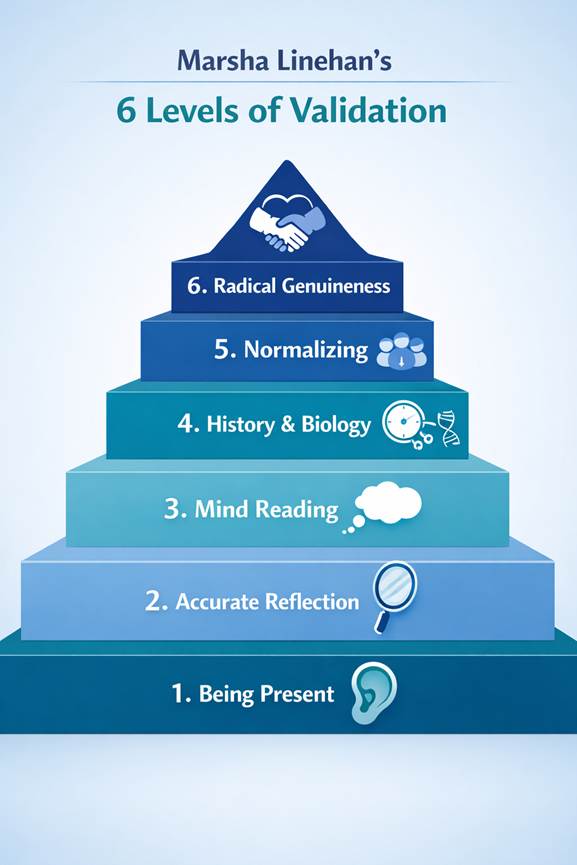
| Level 1: Being Present Showing that you are paying attention to what the person is saying and experiencing |
| Invalidating Response: Continuing to type while someone is talking. Looking at your phone. Appearing distracted. Validating Response: Making eye contact. Turning toward the person. Putting down what you were doing. Saying nothing at all and simply being fully present. |
| Level 2: Accurate Reflection Reflecting back what the person has said or shown without interpretation or addition |
| Invalidating Response: You told me you were fine. You seem like you are handling it well. I do not see why you would feel that way. Validating Response: So what I am hearing is that you felt left out when the decision was made without your input. Did I understand that right? |
| Level 3: Mind Reading Articulating what the person has not said but appears to be feeling or experiencing, in a way that invites rather than insists |
| Invalidating Response: I know how you feel. You obviously feel angry. You must be devastated. Validating Response: It sounds like underneath the frustration there might be some hurt too? I am not sure if that is right, but that is what I am sensing. |
| Level 4: Understanding in Terms of History and Biology Acknowledging that the person’s response makes sense given their history, their patterns, or their particular sensitivity |
| Invalidating Response: You always react like this. This is because of your past. You know this is a pattern for you. Validating Response: Given everything you have been through with this person, it makes complete sense that this brought up such a strong reaction. Your nervous system learned to expect this. |
| Level 5: Normalizing Acknowledging that the person’s response is understandable not just in terms of their history but in terms of what any person might feel in this situation |
| Invalidating Response: Not everyone would feel this way. You need to be more reasonable about this. Most people would just move on. Validating Response: I think most people would feel exactly what you are feeling right now. This is a genuinely hard situation. Anyone in your position would be struggling. |
| Level 6: Radical Genuineness Responding to the person as a full human being whose experience genuinely matters to you, with real presence rather than performed validation |
| Invalidating Response: Performing validation: saying the right words without genuine engagement. I understand how you feel said while clearly wanting the conversation to end. Validating Response: This is less about words and more about presence. It is the difference between someone who is going through the motions of validation and someone who is actually with you in your experience, moved by what moves you, troubled by what troubles you. |
| Kelly’s Perspective | Most people, when they try to validate someone, operate at Levels 1 and 2. They reflect back what was said and show they are listening. That is meaningful, and it is far better than dismissal. The deeper levels of validation, particularly Level 5 and Level 6, are where the most profound relational healing happens. They are also the levels that require the most of us: to truly see another person’s experience as real and important as our own. |
Part 10: Practical Scripts for Validation Across Situations
The following scripts are not formulas to repeat verbatim. They are structures that can be adapted to the specific person and situation. Their purpose is to move beyond the generic I understand toward something that actually lands as genuine acknowledgment.
When Someone Is Expressing Frustration
Instead of: Just try to stay calm. It is not worth getting this worked up about.
Try: This has clearly been building for a while and it makes complete sense that you have hit your limit. What has been the most frustrating part of all this?
When Someone Is Grieving
Instead of: They are in a better place. At least you had so many good years together. Time heals everything.
Try: I am so sorry. There are no words that make this better and I am not going to pretend otherwise. I am just here.
When Someone Is Anxious
Instead of: There is nothing to worry about. You are just being anxious. Think positive.
Try: It makes sense that this feels scary. Uncertainty is genuinely hard, especially when something matters this much to you. What is the biggest worry right now?
When Someone Is Angry
Instead of: Calm down. You are overreacting. This is not that big a deal.
Try: I can see you are really angry about this, and I want to understand what happened. Help me understand what this felt like from where you were standing.
When Someone Is Sharing Something Shameful
Instead of: Why would you do that? I cannot believe you. You should have known better.
Try: Thank you for telling me this. I can imagine it took something to say that. I am not going anywhere.
Validating Yourself When No One Else Will
Instead of: I should not feel this way. I am being ridiculous. Other people have real problems.
Try: It makes sense that I feel this way given everything I have been through. My experience is real even if no one else can see it right now. I am allowed to feel this.
Part 11: Healing from a History of Emotional Invalidation
Recovery from chronic emotional invalidation is possible. The patterns that develop in response to being repeatedly told your feelings are wrong are not permanent features of who you are. They are learned adaptations that can be unlearned, or more precisely, that can be added to by building new experiences of being genuinely seen and understood.
The Role of the Therapeutic Relationship
For many people with significant histories of emotional invalidation, the therapeutic relationship is the first consistent experience of being validated by another person. A skilled therapist, particularly one trained in validation within a DBT framework, provides something that was absent in the formative environment: a relationship in which emotional expression is consistently met with genuine acknowledgment rather than dismissal or punishment.
This consistent experience of validation in therapy is not just comforting. It is corrective. It provides the nervous system with new data about what happens when emotions are expressed: not punishment or dismissal, but presence and acknowledgment. Over time, this new data changes the internal model that governs emotional expression.
Building Validation Skills for Your Own Relationships
Recovery from invalidation is not only about receiving more validation. It is also about developing the capacity to choose relationships in which validation is available, to recognize invalidation when it occurs and respond to it with self-protective clarity rather than collapse, and to become a more validating person yourself.
The six levels of validation described in Part 9 are not only useful for understanding what others do or do not offer. They are a roadmap for developing your own capacity to validate, which changes the quality of every relationship you are in.
| From Our Clients | Kelly has changed how I view therapy and really helped me grow. She has never made me feel judged. In the year I have been seeing her, I have felt that I made real progress in my life and how I regulate emotions. The experience of being consistently validated, I think, was part of what made the skills feel possible to build. |
Getting Support
If you recognize your own experience in this guide, whether as someone who has been chronically invalidated or as someone who has invalidated others without fully understanding the impact, the most important thing to know is that these patterns are not fixed.
DBT treatment specifically targets both the self-invalidation that develops from chronic invalidation and the emotional dysregulation that results from growing up in an invalidating environment. It provides both the skills and the therapeutic relationship in which healing from invalidation can actually happen.
| Healing from Emotional Invalidation with DBT Southside DBT provides comprehensive, board-certified DBT treatment for emotional dysregulation, BPD, PTSD, and the long-term effects of invalidating environments via telehealth across Georgia. Kelly Pinnick | DBT-Linehan Board of Certification, Certified Clinician (770) 880-2538 | kelly@southsidedbt.com Accepting: Aetna | Anthem BCBS GA | Cigna | United Healthcare | Self-Pay $150/session |