
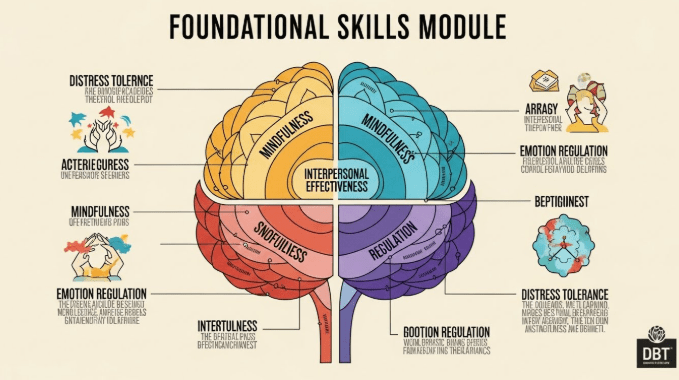
What is the Foundational Skills Module in DBT?
Dialectical Behavior Therapy (DBT) is a highly effective, evidence-based approach for managing intense emotions, improving relationships, and coping with life’s challenges. At the heart of DBT lies the foundational skills module, the first core component that equips participants with essential abilities for emotional regulation, mindfulness, distress tolerance, and interpersonal effectiveness.
Whether you’re struggling with anxiety, anger, impulsivity, or relationship difficulties, understanding and practicing these foundational skills provides a stable base for all subsequent DBT techniques, enabling you to navigate life with confidence and resilience. In this guide, we’ll dive into what the foundational skills module is, its components, benefits, practical applications, and how to integrate it into daily life.
Short Answer: Understanding the Foundational Skills Module in DBT
The foundational skills module in DBT is the first core module designed to teach essential skills that help individuals manage emotions, tolerate distress, and improve relationships effectively. Its purpose is to equip people with a strong skill set to navigate life’s challenges safely and prevent emotional crises.
Practical example: If you feel overwhelmed by conflict at work, foundational DBT skills can help you stay present, manage emotional reactions, and communicate effectively without escalating tension.
Core Explanation of the Foundational Skills Module in DBT
Origins and Purpose
DBT was developed by Dr. Marsha Linehan to support individuals who experience intense emotional swings, self-harming behaviors, and relational instability, particularly those diagnosed with borderline personality disorder. The foundational skills module is essential because it builds the core skills needed before progressing to more advanced DBT modules.
The module connects closely with four pillars of DBT:
- Mindfulness: Enhances awareness and presence
- Distress Tolerance: Provides tools for surviving crises
- Emotional Regulation: Reduces vulnerability and improves control
- Interpersonal Effectiveness: Strengthens communication and relationships
Without a solid foundation, individuals may struggle with advanced techniques or fail to apply skills consistently in real-life situations.
Components of the Foundational Skills Module
The foundational skills module consists of four primary components:
- Mindfulness Skills
- Observe, describe, and participate fully in the present moment
- Practice non-judgmental awareness of thoughts and feelings
- Distress Tolerance Skills
- Crisis survival strategies, radical acceptance, and self-soothing
- Focus on staying safe during emotional upheavals
- Emotional Regulation Skills
- Identify, understand, and manage emotions
- Reduce emotional vulnerability and increase positive experiences
- Interpersonal Effectiveness Skills
- Communicate needs assertively
- Set healthy boundaries and maintain balanced relationships
Psychological and Emotional Benefits
Engaging with the foundational skills module offers numerous benefits:
- Improved self-awareness: Recognize patterns in emotions and behaviors
- Reduced impulsive behaviors: Respond thoughtfully rather than reactively
- Better handling of relationships: Navigate conflicts with clarity and calm
- Enhanced resilience: Build mental strength for daily challenges and long-term growth
Why the Foundational Skills Module is Important
The foundational skills module is critical because it:
- Prepares participants for advanced DBT modules
- Prevents emotional burnout and overwhelm
- Ensures personal safety in high-stress situations
Real-life applications:
- Managing anger in personal or professional relationships
- Coping with anxiety during exams or high-pressure work
- Preventing self-harm or impulsive reactions in emotional crises
By mastering these foundational skills, individuals can approach life’s challenges with a calm, structured, and confident mindset.
How the Foundational Skills Module Works
Guide to Learning and Applying Foundational DBT Skills
- Begin with Mindfulness Training
- Observe thoughts, emotions, and behaviors without judgment
- Mini exercise: Spend 5 minutes noticing your breath and bodily sensations
- Learn Distress Tolerance Skills
- Apply strategies like radical acceptance or distraction to survive crises
- Tip: Create a “self-soothing kit” with music, scents, or tactile items
- Develop Emotional Regulation Skills
- Track emotions with a daily mood log
- Reduce reactivity by practicing pause-and-breathe techniques
- Practice Interpersonal Effectiveness Skills
- Assertively communicate needs and set boundaries
- Role-play conversations to strengthen skills in low-stakes situations
- Integrate Skills into Daily Life
- Use skills proactively for stress management, not just reactively
- Set reminders to practice mindfulness or emotional tracking
- Reflect and Adjust
- Identify which skills are most effective for your patterns
- Adjust approaches as needed for ongoing improvement
Tip for Beginners: Start small with one skill per week and gradually integrate all components.
Foundational Skills Module vs. Other DBT Modules
| Module | Definition | Primary Goal | Practical Use | Emotional Impact |
|---|---|---|---|---|
| Foundational Skills | Core skills for emotional and behavioral stability | Build a strong skill base | Daily life, stress management, relationships | Increased control, resilience |
| Advanced DBT Skills | Complex skills for problem-solving and personal growth | Apply DBT in challenging situations | Therapy sessions, life transitions | Deep insight, mastery |
| Crisis Intervention | Immediate techniques to manage acute distress | Prevent harm | During high-intensity crises | Immediate safety, stabilization |
Takeaway: Foundational skills create the base for sustained emotional control, while advanced and crisis-focused modules target specific, high-intensity situations.
Common Questions About the Foundational Skills Module
FAQs
- How long does it take to complete the foundational skills module in DBT?
Typically 6–12 weeks, depending on session frequency and individual pace. - Can beginners benefit from DBT without the foundational skills module?
The module is recommended first, as it provides the skills necessary to safely engage in advanced DBT. - What are the most essential skills taught in the foundational module?
Mindfulness, distress tolerance, emotional regulation, and interpersonal effectiveness. - How does the foundational skills module improve emotional regulation?
By providing techniques to track, manage, and respond to emotions thoughtfully rather than reactively. - Can these skills prevent self-harm or impulsive behaviors?
Yes, they provide coping strategies that stabilize intense emotions and prevent destructive actions. - How do foundational skills interact with mindfulness and distress tolerance?
Mindfulness enhances awareness, while distress tolerance provides tools for surviving crises—both are integrated in the foundational module. - Are these skills applicable outside therapy?
Absolutely; they are designed for real-life use in daily interactions, work, and personal growth. - Can the foundational skills module be customized for individual needs?
Yes, therapists often tailor exercises to address personal triggers and life circumstances.
Real-Life Applications of the Foundational Skills Module
- Managing daily stress: Reduces overwhelm and enhances decision-making
- Handling interpersonal conflicts: Apply assertiveness and empathy to maintain healthy relationships
- Coping with anxiety or depression: Stabilizes emotional responses safely
- Preparing for advanced DBT modules: Provides a strong skill base for complex interventions
Tips for Maximizing the Foundational Skills Module
- Practice consistently in low-stress moments to build automaticity
- Use journaling or apps to track skill practice and progress
- Pair skills with mindfulness exercises to reinforce awareness
- Engage in DBT groups or therapy sessions to practice in real-world scenarios
Conclusion
The foundational skills module in DBT is a critical starting point for anyone looking to manage emotions effectively, cope with stress, and build stronger relationships. Acquire services from South Side DBT to master mindfulness, distress tolerance, emotional regulation, and interpersonal effectiveness, individuals develop a solid base for all advanced DBT techniques, empowering them to navigate life’s challenges safely and confidently.
Consistent practice, reflection, and real-world application of these skills can transform emotional reactivity into resilience, laying the groundwork for long-term mental and emotional well-being. For a comprehensive DBT journey, integrate these foundational skills with advanced modules and crisis interventions for a complete emotional mastery toolkit.