
Eating Disorder Support: Immediate Resources and DBT Strategies
Introduction:
Struggling with emotional eating, bingeing, or restrictive food behaviors can feel like an isolating battle. In moments of high distress, it is common to feel like you’ve lost control over your actions and emotions. While long-term therapy is essential for recovery, having access to immediate support can be life-saving.
If you are in a crisis right now, there are professional hotlines available to listen and guide you. Additionally, Dialectical Behavior Therapy (DBT) provides physical and mental tools you can use immediately to manage intense urges.
Immediate Support Resources
If you need someone to talk to right now, please reach out to these confidential and free services:
- 988 Suicide and Crisis Lifeline:
Dial or text 988 anytime for 24/7 support. This service is confidential and connects you with trained counselors. - Crisis Text Line:
Text HELLO to 741741 to connect with a crisis counselor over text. - ANAD Helpline:
The National Association of Anorexia Nervosa and Associated Disorders provides support between 8 a.m. and 8 p.m. EST at 1 (888) 375-7767. - National Alliance for Eating Disorders Hotline:
Call 1-866-662-1235 between 9 a.m. and 7 p.m. Monday through Friday to speak with a licensed mental health professional.
Using DBT Skills to Manage Urges in the Moment
While hotlines provide a space to be heard, DBT skills offer you a way to physically reset your body when an urge to eat or restrict feels overwhelming.
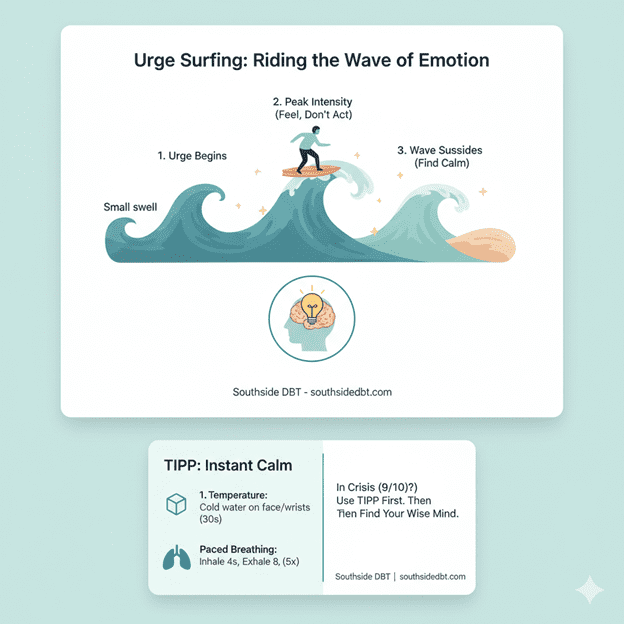
TIPP for Immediate Urge Reduction
When your distress level is at a 9 or 10, your logical brain shuts down. TIPP skills help you bypass the urge by changing your body chemistry.
- Temperature: Splash ice-cold water on your face or hold an ice pack to your eyes and cheeks for 15 to 30 seconds. This triggers the Mammalian Dive Reflex, which naturally slows your heart rate and reduces emotional intensity.
- Paced Breathing: Slow your breathing down to about 5 to 7 breaths per minute. Exhale longer than you inhale to activate your Vagus Nerve and signal safety to your brain.
Urge Surfing
An urge to engage in disordered eating is like a wave in the ocean. It starts small, builds to a peak of intensity, and then eventually subsides.
The Technique: Instead of fighting the urge or giving in to it, imagine yourself as a surfer on top of the wave. Notice the physical sensations in your body without acting on them. Remind yourself that the wave will eventually reach the shore and disappear.
Long Term Recovery with Southside DBT
Hotlines are an excellent resource for managing an immediate crisis, but they are not a substitute for clinical treatment. Sustainable recovery involves understanding the emotional roots of your relationship with food.
At Southside DBT, we help you transition from crisis management to emotional mastery. By learning to regulate your emotions and tolerate distress, you can build a life where food no longer serves as your primary coping mechanism.