
What Is Anxious Avoidant Attachment?
A Complete Guide to the Push-Pull Cycle, Neuroscience, DBT Skills, and Healing
By Kelly Pinnick, DBT-Linehan Board of Certification, Certified Clinician | Southside DBT | Telehealth across Georgia
You want closeness more than almost anything. And when someone gets close, something in you makes you pull away.
Or: you are the one who reaches, presses, needs reassurance, and watches the other person withdraw. And the more they withdraw, the more desperately you need them to come back.
These are the two sides of the attachment dynamic that is sometimes called anxious-avoidant. It is one of the most discussed, most misunderstood, and most personally painful relationship patterns that people bring to therapy.
This guide goes far beyond the brief overview provided by Columbia Psychiatry’s article on this topic. It explains what attachment theory actually is and where it comes from, the four adult attachment styles clearly distinguished from one another, the specific nature of the fearful-avoidant pattern that most people mean when they say anxious-avoidant, the neuroscience of why these patterns are so persistent, what happens when an anxious and avoidant person end up in relationship together, real-world scenarios, a self-reflection guide, and how DBT skills directly address the patterns that insecure attachment produces.
Part 1: Attachment Theory — Where It Comes From and Why It Matters
Attachment theory was developed by British psychiatrist and psychoanalyst John Bowlby in the 1950s and 1960s. Bowlby proposed that human beings, like other mammals, come into the world with a biologically wired system for seeking proximity to caregivers when threatened or distressed. This attachment behavioral system evolved because proximity to a protective caregiver is literally necessary for infant survival.
The central insight of attachment theory is that the quality of early attachment relationships does not simply determine whether the child feels loved at the time. It shapes the internal working models that the child develops: mental representations of self, others, and relationships that become the blueprint for how the person approaches intimacy, dependence, and vulnerability throughout life.
Mary Ainsworth, a developmental psychologist who worked alongside Bowlby, conducted the seminal research that identified distinct attachment patterns through her Strange Situation experiments in the 1970s. Her work with infants identified three initial patterns: secure, anxious, and avoidant. A fourth pattern, disorganized, was later identified by Mary Main.
In the 1980s, researchers Cindy Hazan and Philip Shaver demonstrated that these attachment patterns persist into adult romantic relationships, becoming the foundation for what is now called adult attachment theory.
| Attachment patterns are not destiny. They are deeply ingrained relational blueprints that can, with the right conditions and support, be updated. Understanding your pattern is the beginning of changing it. |
Part 2: The Four Adult Attachment Styles — A Clear Distinction
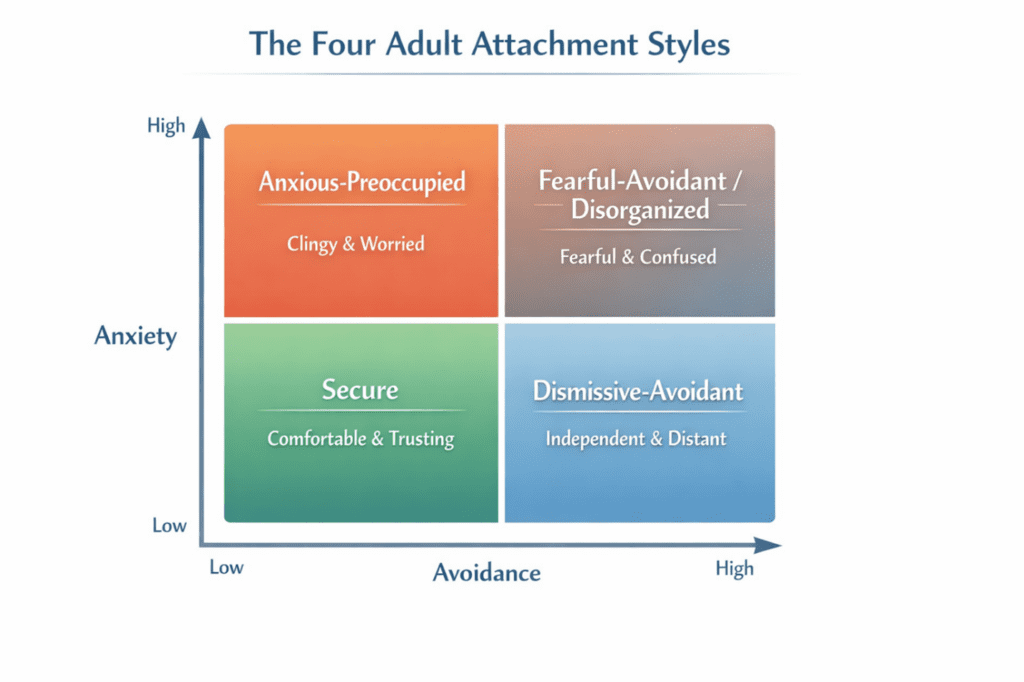
Before understanding the anxious-avoidant pattern specifically, it helps to have each of the four attachment styles clearly distinguished. One of the most common sources of confusion in popular attachment writing is that these patterns are described vaguely or interchangeably.
| Secure Attachment |
| Internal Working Model: I am worthy of love. Others are trustworthy and available. Closeness is safe. Early Caregiver Pattern: Consistently responsive, attuned, and available. Distress reliably met with comfort. Adult Relationship Behavior: Comfortable with intimacy and independence. Manages relationship challenges without extremes. Can soothe self and reach for support appropriately. |
| Anxious (Preoccupied) Attachment |
| Internal Working Model: I may not be worthy of love. Others are available sometimes but not reliably. I need to work to keep closeness. Early Caregiver Pattern: Inconsistently responsive: sometimes warm and available, sometimes withdrawn, distracted, or overwhelmed. The child could not predict when comfort would come. Adult Relationship Behavior: Hyperactivates attachment system. Seeks constant reassurance. Fears abandonment intensely. Highly attentive to partner’s emotional state. May become clingy, demanding, or emotionally reactive. |
| Avoidant (Dismissing) Attachment |
| Internal Working Model: Others are not reliably available. I must be self-sufficient. Closeness leads to disappointment or rejection. Early Caregiver Pattern: Consistently unresponsive or rejecting of emotional needs. The child learned that expressing need produced either indifference or negative response. Adult Relationship Behavior: Deactivates attachment system. Values independence over connection. Uncomfortable with emotional closeness. May minimize own feelings and others’ needs. Appears self-sufficient but maintains emotional distance. |
| Disorganized (Fearful-Avoidant) Attachment |
| Internal Working Model: I need closeness AND closeness is dangerous. I both want and fear the person I most need. Early Caregiver Pattern: The caregiver was both the source of comfort and the source of fear. Often seen in neglectful, abusive, or severely inconsistent caregiving environments. Adult Relationship Behavior: Simultaneously activates and deactivates attachment system. Desires intimacy intensely while fearing it equally. Experiences push-pull cycle in relationships. Often has difficulty with emotional regulation. Associated with trauma history. |
| Clinical Clarification | When people use the term anxious-avoidant attachment, they usually mean one of two things: the disorganized or fearful-avoidant style described above, OR the specific relationship dynamic that occurs when an anxiously attached person and an avoidantly attached person are in relationship together. This guide addresses both. |
Part 3: Fearful-Avoidant Attachment — The Pattern Behind the Push-Pull
Fearful-avoidant attachment, which is the clinical term most closely aligned with what most people mean by anxious-avoidant, is the most complex and often the most distressing of the insecure attachment patterns. It is the only style in which both poles of the attachment system, the drive toward closeness and the drive away from it, are strongly activated simultaneously.
The Core Internal Conflict
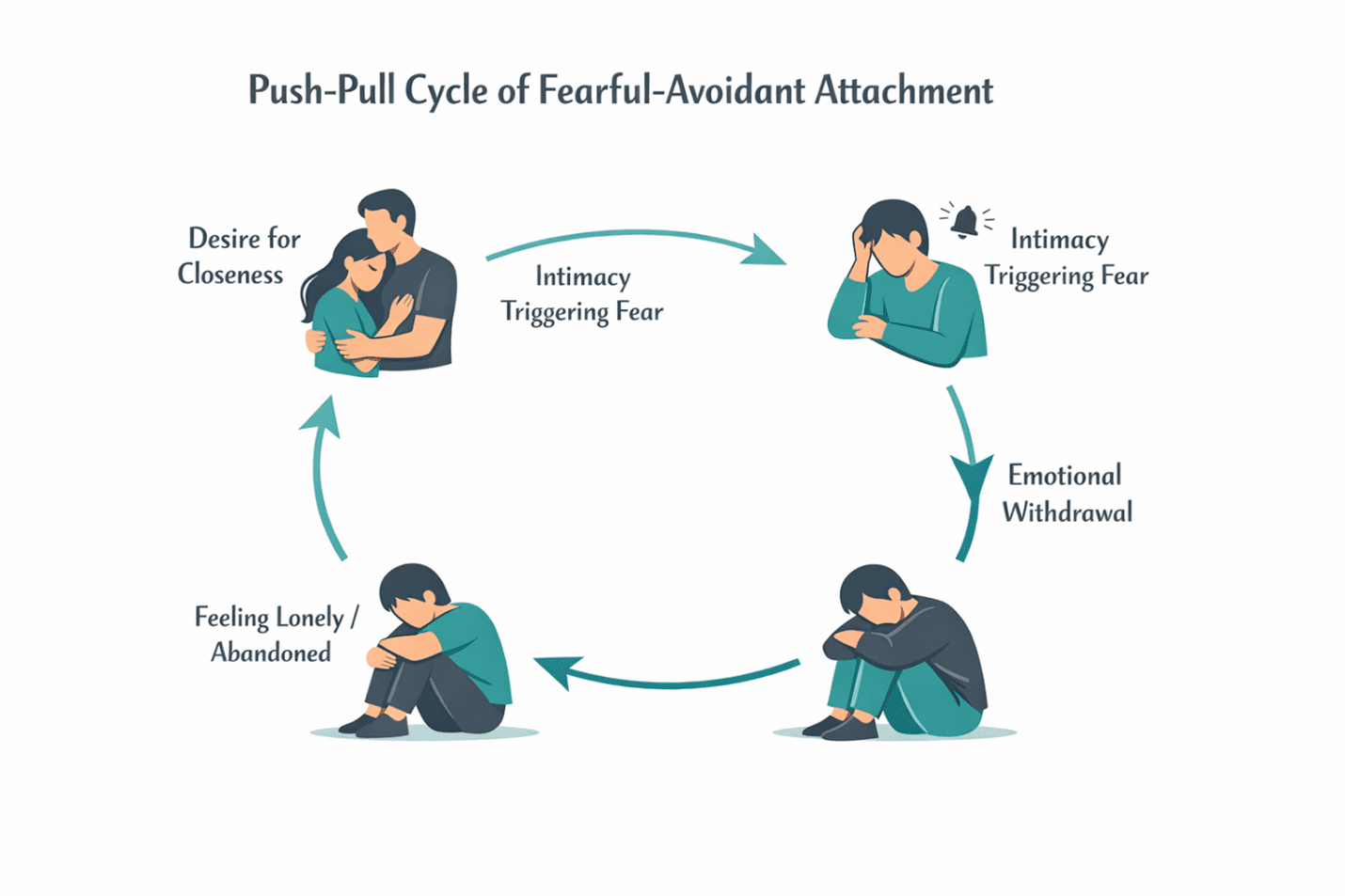
The internal experience of fearful-avoidant attachment is captured in one sentence: I desperately want to be close to you, and I am terrified of how much I want that.
The desire for closeness is real and powerful. The fear is equally real and powerful. What creates the distinctive push-pull cycle is that neither force wins. The person moves toward connection, the closeness then activates the fear of abandonment or rejection, and they pull back. The distance then activates the longing, and they move toward again. This oscillation can happen within minutes in a conversation or across months in a relationship.
How Fearful-Avoidant Attachment Develops
Fearful-avoidant attachment typically develops when the early attachment relationship contained both the need for connection and the experience of that need being met with fear, unpredictability, or harm. The caregiver who was the child’s primary source of safety was also a source of threat, whether through direct harm, severe inconsistency, emotional unavailability, or frightening behavior.
The child in this situation faces an unresolvable dilemma that Bowlby called fright without solution: the biological system says go toward the caregiver for comfort, but the caregiver is the source of the fright. The result is a disorganized attachment system that has no coherent strategy for managing closeness and threat.
This does not only develop in obviously abusive environments. It can also develop when a caregiver was deeply depressed and therefore emotionally absent, when they were extremely anxious and transmitted threat signals to the child, when they were neglectful, or when the child experienced trauma within a primary attachment relationship.
Part 4: The Neuroscience of Attachment Patterns
Understanding what is happening neurologically in insecure attachment patterns helps explain why they are so persistent and why they do not respond to simply knowing better or trying harder.
Internal Working Models as Neural Networks
Internal working models are not abstract psychological constructs. They are encoded as neural networks, patterns of neuronal activation that become the default processing framework for social and emotional information. These networks are laid down during the most neuroplastic period of brain development, early childhood, and they become progressively more entrenched as they are repeatedly activated.
By adulthood, the internal working model is not a conscious belief that the person can simply decide to change. It is a deeply ingrained set of predictive patterns that the brain uses to process social situations before conscious thought has time to intervene. This is why a person with fearful-avoidant attachment can know intellectually that their partner is safe and still experience their nervous system responding as though the partner is a threat.
The Attachment System and the Threat Detection System
The attachment system and the threat detection system share significant neurological architecture. Both involve the amygdala, the brain’s threat detection center. In secure attachment, the amygdala’s threat response is down-regulated by the experience of the caregiver as a safe base. In insecure attachment, the attachment system and the threat detection system become entangled in ways that persist into adult relationships.
For people with fearful-avoidant attachment, closeness itself becomes an amygdala trigger. The very thing the attachment system is seeking activates the threat response that makes it feel dangerous. This explains why logical reassurance does not resolve the pattern. The activation is subcortical, happening before conscious processing, and it requires experiences rather than explanations to change.
The Neurobiology of the Push-Pull Cycle
Research on attachment has illuminated the neurochemical dynamics of the push-pull pattern. Seeking closeness activates the brain’s reward system, producing dopamine and the pleasurable anticipation of connection. But for someone with fearful-avoidant attachment, closeness also activates stress hormones and the threat response. The oscillation between these two states, the reward drive toward closeness and the threat response away from it, produces the characteristic instability of the pattern.
This neurochemical oscillation can itself become addictive in the most literal sense: the intermittent reinforcement of closeness followed by withdrawal activates the same dopamine systems as variable reward schedules, which produce the strongest and most persistent behavioral patterns in learning research. This is one reason why people often describe their most intense relationships as those with people whose attachment pattern produced this oscillation.
Part 5: Fearful-Avoidant Attachment in Real Life
Abstract descriptions of attachment patterns become meaningful through concrete recognition. The following scenarios illustrate how fearful-avoidant attachment manifests in real relationships.
| The First Date That Goes Too Well |
| Situation: A first date is genuinely wonderful. The conversation flows easily, there is real chemistry, and the person feels seen in a way they rarely experience. |
| Anxious-Avoidant Response: They drive home feeling great, then spend the rest of the evening dismantling it in their mind. They list reasons why it probably will not work, or they convince themselves that the other person was performing and cannot actually be that good. They may not text back for several days, or they may text immediately and then feel panicked about having done so. What is driving it: The quality of the connection itself is a threat signal. Being truly seen triggers the fear: if they really get close, I will be abandoned or hurt. Distance is managed by self-sabotage before the other person can do it. |
| Healthier Alternative: Notice the shutdown and name it: I am starting to protect myself from something that does not have to be a threat. What I felt tonight was real. I can text back without deciding what this means. |
| A Partner Asks for Space |
| Situation: After a period of closeness, a partner says they need a few days to themselves. There is no indication of a problem. They just need time alone. |
| Anxious-Avoidant Response: The request for space is interpreted as rejection or withdrawal of love. The person may become anxious and seek contact during the space, or may withdraw completely and go cold before the partner does, wanting to be the one to leave rather than the one who is left. What is driving it: The request for space activates the fear of abandonment. When abandonment is felt as imminent, the options the attachment system perceives are: desperately pursue to prevent abandonment, or leave first to avoid being left. |
| Healthier Alternative: This is my partner needing recharge time, not withdrawing love. I can tolerate this discomfort without acting on it. I will use this time for my own self-care and we will reconnect soon. |
| The Relationship That Felt Impossible to Stay In and Impossible to Leave |
| Situation: A relationship that has cycled between deep intimacy and painful distance multiple times over months or years. |
| Anxious-Avoidant Response: The person cannot fully commit to the relationship because the closeness is threatening, but they also cannot fully leave because the disconnection is unbearable. They may stay in a state of chronic ambivalence, never fully present and never fully gone. What is driving it: This is the core fearful-avoidant pattern in action: the desire for closeness and the fear of closeness are both maximally activated. The relationship becomes a holding pattern that satisfies neither. |
| Healthier Alternative: I need to understand what I actually want from this relationship and what is preventing me from either committing to it or leaving it. This requires therapy, not just more cycling. |
Part 6: Self-Reflection Guide — Anxious, Avoidant, or Fearful-Avoidant?
The following questions help identify which attachment patterns are most active in your relational experience. Patterns often overlap, and recognizing which dimension is more prominent helps clarify what kind of support would be most useful.
| Does This Apply to You? | Anxious | Avoidant |
| I frequently worry about whether my partner really loves me or will stay | Anxious | |
| I feel more comfortable when I have a lot of independence in relationships | Avoidant | |
| I want closeness deeply AND something about getting it makes me want to pull away | Anxious | Avoidant |
| When things go well in a relationship I start waiting for something to go wrong | Anxious | |
| When I feel close to someone I find myself looking for exit routes | Avoidant | |
| I feel suffocated when partners want a lot of connection | Avoidant | |
| I monitor my partner’s emotional state closely for signs they might be withdrawing | Anxious | |
| I tend to minimize my own emotional needs in relationships | Avoidant | |
| I have left relationships or created distance right at the point they were becoming most intimate | Avoidant | |
| I have stayed in relationships long after they should have ended because leaving felt unbearable | Anxious | |
| I find myself both needing reassurance AND dismissing it as insufficient when it comes | Anxious | Avoidant |
| I tend to idealize partners at first and then find reasons to devalue them later | Anxious | Avoidant |
| When someone pulls away I pursue; when they come close I pull away | Anxious | Avoidant |
| I have been told I run hot and cold in relationships | Anxious | Avoidant |
Items marked with both Anxious and Avoidant are characteristic of fearful-avoidant attachment specifically. If you recognize yourself in many of these, particularly the both-marked items, fearful-avoidant attachment is likely a significant pattern in your relational experience.
Part 7: When Anxious and Avoidant Attachment Meet in a Relationship
One of the most painful and common relationship dynamics occurs when a person with anxious attachment is in a relationship with a person with avoidant attachment. This pairing is so frequent that it is sometimes called the anxious-avoidant trap.
Why This Pairing Happens So Often
Anxious and avoidant people are often intensely drawn to each other, and the draw is not accidental. For the anxiously attached person, the avoidant partner’s emotional distance confirms the internal working model: connection requires pursuit and effort, closeness must be earned, and the partner’s occasional warmth is all the more precious for being unpredictable. The intermittent reinforcement activates exactly the attachment system hyperactivation that defines anxious attachment.
For the avoidantly attached person, the anxious partner’s need for reassurance and closeness activates the deactivating strategy of distancing. The more the anxious partner pursues, the more overwhelming the closeness feels and the further the avoidant partner retreats. This confirms the avoidant’s internal working model: closeness leads to suffocation, independence is necessary.
The Cycle That Develops
The anxious-avoidant relationship cycle is self-reinforcing. The anxious partner pursues. The avoidant partner distances. The distancing activates more anxiety in the anxious partner, producing more pursuit. The increased pursuit activates more overwhelm in the avoidant partner, producing more distancing. Neither partner is behaving intentionally or maliciously. Both are enacting their attachment system’s learned strategy for managing the threat of connection.
Breaking this cycle requires both partners to understand their own attachment patterns and their contribution to the dynamic. This is not a blame-assignment exercise. Both patterns are the products of developmental history that neither person chose. What both can choose is whether to continue the cycle or to develop a different way of responding.
| Neither the anxious nor the avoidant person is doing something wrong. Both are protecting themselves using the best strategies they developed given what they learned about relationships early in life. The cycle is the problem, not the people. |
Part 8: Fearful-Avoidant Attachment and BPD
The connection between fearful-avoidant attachment and Borderline Personality Disorder is clinically significant and directly relevant to the work of Southside DBT.
Research consistently shows that disorganized or fearful-avoidant attachment is the most common attachment pattern in people with BPD, with some studies finding rates of eighty to ninety percent. This is not surprising given that the biosocial theory of BPD development involves exactly the conditions, a sensitive temperament plus an invalidating environment, that produce disorganized attachment.
The core features of BPD, fear of abandonment, unstable relationships characterized by idealization and devaluation, identity instability, emotional dysregulation, impulsivity, and chronic emptiness, can all be understood as expressions of a disorganized attachment system operating without adequate regulatory skills. The frantic efforts to avoid abandonment are the hyperactivation of the attachment system. The devaluation and withdrawal are the deactivation strategy. The oscillation between them is the disorganized pattern.
This is one of the most important reasons DBT was developed specifically for BPD. DBT’s interpersonal effectiveness module directly addresses the relational patterns that insecure attachment produces. The therapeutic relationship in DBT itself provides a structured, safe, consistent attachment experience that many clients with BPD have never had.
Part 9: DBT Skills for Attachment Patterns
DBT was not developed specifically as an attachment therapy, but its skills directly address the emotional and behavioral patterns that insecure attachment produces. The following skills are particularly relevant.
| DBT Skill: Check the Facts |
| Why It Helps: Insecure attachment produces systematic misinterpretations of relational information. A neutral text message is read as withdrawal. A request for space is interpreted as rejection. Checking the facts interrupts the pattern of interpreting through the attachment lens before examining what is actually happening. Practical First Step: When you notice a strong emotional response to a partner’s behavior, ask: what are the actual facts? What am I adding through interpretation? What would a person with secure attachment reasonably conclude about this situation? |
| DBT Skill: Opposite Action for Attachment Avoidance |
| Why It Helps: When the avoidant impulse fires, telling you to pull back from someone who is getting too close, opposite action means deliberately moving toward connection rather than away from it, even when the approach feels threatening. Practical First Step: Identify one situation this week where you feel the pull to create distance. Instead, do one small thing that moves toward connection: send a message, agree to a plan you would normally avoid, or share something personal you would normally keep to yourself. |
| DBT Skill: Opposite Action for Anxious Pursuit |
| Why It Helps: When the anxious impulse fires, telling you to pursue, check, seek reassurance, or press for closeness to reduce the fear of abandonment, opposite action means tolerating the discomfort without acting on the urge to pursue. Practical First Step: When you notice the urge to check on a partner, seek reassurance, or press for response, use distress tolerance skills first to bring the emotional intensity down. Then ask: if I do not act on this urge for the next two hours, will I be glad I did not? Usually the answer is yes. |
| DBT Skill: DEAR MAN for Expressing Attachment Needs |
| Why It Helps: Insecure attachment often produces either hyperactivated emotional expression of needs, which tends to push avoidant partners away, or complete suppression of needs, which leaves anxious people without the connection they require. DEAR MAN provides a structured way to express needs that is more likely to be heard. Practical First Step: Practice saying what you need directly and calmly: I need more connection this week. I would like us to spend an evening together without phones. I felt hurt when you did not respond. This is different from I cannot believe you do not care about me or I do not need anything from you. |
| DBT Skill: Mindfulness of Attachment Triggers |
| Why It Helps: Attachment responses fire before conscious awareness in most cases. Developing mindfulness of the moment when an attachment trigger is activated creates the space to choose a response rather than enact a pattern. Practical First Step: Begin noticing the physical sensations that come with attachment activation: tightness in the chest when a partner seems distant, the pull in the stomach when someone is getting close. Name the sensation without immediately acting. This moment of naming is the beginning of regulation. |
| DBT Skill: Radical Acceptance of Attachment History |
| Why It Helps: The attachment pattern you developed was not your fault. Fighting against the fact that early relationships shaped your current relational experience is a form of secondary suffering that adds to the pain without reducing it. Radical acceptance allows you to acknowledge the history without being controlled by it. Practical First Step: When the attachment pattern produces consequences you regret, try: this is how my nervous system learned to protect itself. It made sense then. I am learning a different way. This is not a justification for continuing the pattern. It is an acknowledgment that the pattern has a history. |
Part 10: Can Attachment Style Change?
This is one of the most important questions for anyone who has identified a painful attachment pattern in themselves and is wondering whether there is any hope of it being different.
The answer, supported by decades of research, is yes.
Attachment styles can change, and they do change, through what researchers call corrective emotional experiences: sustained relational experiences that provide enough safety, consistency, and attunement to begin updating the internal working model. These experiences can happen in romantic relationships, in friendships, in therapeutic relationships, and through deliberate skills practice.
The Role of Therapy in Changing Attachment Patterns
Therapy is one of the most reliable vehicles for attachment change because a therapeutic relationship, when it is done well, provides precisely the elements that produce secure attachment: consistency, availability, non-judgmental attunement, and the experience of having one’s emotional reality acknowledged and held.
In DBT specifically, the therapeutic relationship is explicitly structured as a secure base. The therapist is consistent, available for phone coaching, and committed to working through ruptures in the relationship rather than allowing them to go unaddressed. For clients whose attachment histories involved inconsistency, unavailability, or frightening caregiving, the consistent, boundaried warmth of a DBT therapeutic relationship is itself a corrective experience.
What Change Actually Looks Like
Attachment change does not typically mean becoming a completely different person with a completely different relational style. It means developing what researchers call earned security: the capacity to function in relationships in more secure ways even while retaining some of the sensitivity and vigilance of the original insecure pattern.
People with earned security still feel the attachment activations when they occur. The difference is that they have more regulatory capacity, better interpersonal skills, and a more accurate internal working model that allows them to interpret relational information more accurately and respond to it more flexibly. They are not cured of their history. They are no longer controlled by it.
| Kelly’s Perspective | The clients who make the most meaningful changes in their attachment patterns are not necessarily the ones with the least damage in their histories. They are the ones who learn to recognize their pattern in real time, develop the skills to regulate what the pattern activates, and stay in a therapeutic relationship long enough for a different experience of being known to become part of how they understand themselves. |
Starting the Work
If you have recognized yourself in this guide, the most important thing to know is that the pattern you have identified is not a verdict about who you are. It is a description of how your nervous system learned to protect you in the context of early relationships that may not have provided the safety it needed.
The pattern can change. The work is real and it takes time. But the people who are most deeply changed by that work often describe it as one of the most significant things they have ever done, not only for their romantic relationships but for every relationship in their lives and for their relationship with themselves.
| Working Through Attachment Patterns in Georgia? Southside DBT provides comprehensive DBT treatment that directly addresses the interpersonal effectiveness and emotional regulation skills that support attachment healing, via telehealth across Georgia. Kelly Pinnick | DBT-Linehan Board of Certification, Certified Clinician (770) 880-2538 | kelly@southsidedbt.com Accepting: Aetna | Anthem BCBS GA | Cigna | United Healthcare | Self-Pay $150/session |