
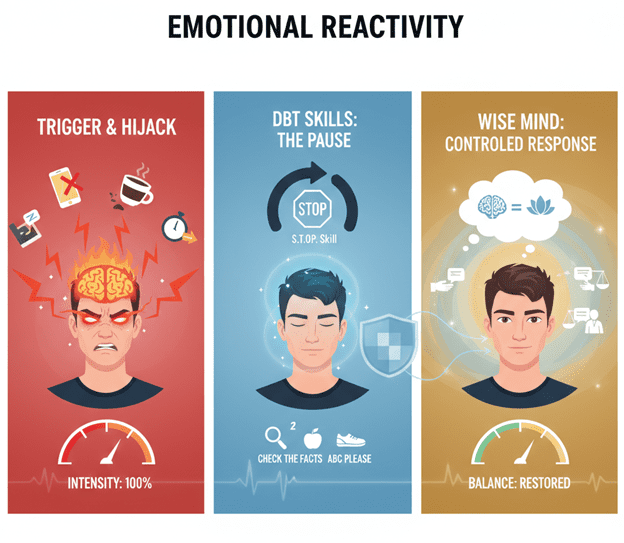
Emotional Reactivity: Why You Overreact and How to Take Back Control
Do you feel like you have an emotional “hair-trigger”? One small comment, a misunderstood text, or a minor delay, and suddenly you are consumed by intense anger or deep sadness. You aren’t dramatic or crazy you likely have high emotional reactivity. At Southside DBT, we view this as a sensitive nervous system that needs a better braking system.
What is Emotional Reactivity? (The 0-to-100 Scale)
Emotional reactivity is the tendency to respond to triggers with emotions that are more intense and last longer than the situation warrants.
- High Sensitivity: You pick up on vibes or tone changes that others miss.
- High Intensity: Your “small” annoyance feels like a huge rage.
- Slow Return to Baseline: Once you’re upset, it takes you hours not minutes to feel calm again.
The Science: Why is Your Thermostat So Sensitive?
Research suggests that reactivity is often a mix of biology and environment.
- Biological Vulnerability: Some people are born with a more active Amygdala (the brain’s alarm system). Your emotional skin is simply thinner than others.
- The Invalidation Cycle: If you grew up in an environment where your feelings were ignored or punished until you exploded, your brain learned that extreme reactivity is the only way to be heard or get results.
Breaking the Cycle: DBT Skills for the Reactive Mind
To end the cycle of reactivity, you need a gap between the Trigger and the Reaction. Here is how DBT helps you build that gap:
1. The STOP Skill (The Emergency Brake)
The moment you feel that heat rising in your chest, use STOP:
- Stop: Freeze! Do not say a word, make a face, or send that text.
- Take a step back: Physically walk out of the room or mentally detach from the situation.
- Observe: What is happening? My heart is racing, I’m feeling judged, and the other person looks frustrated.
- Proceed Mindfully: Ask your Wise Mind, Will my reaction make this better or worse in the long run?
Why it works: The STOP skill interrupts emotional intensity before it escalates and helps you re-engage your rational brain.
2. Check the Facts
Reactivity is often fueled by interpretations and mind-reading, not facts.
- Example: If someone hasn’t texted back, the Fact is: They haven’t replied. The Interpretation is: They are ignoring me because they are mad. Checking the facts lowers the emotional temperature immediately.
Why it works: This skill helps you separate feelings from facts, which prevents your emotions from spiraling into a crisis.
3. ABC PLEASE (Building a Buffer)
You are 10x more reactive when you are tired, hungry, or stressed. By managing your physical health (Sleep, Nutrition, Exercise), you increase your emotional floor.
Why it works: Self-care and preparation increase emotional resilience, making it much harder for small things to trigger a big fall.
Moving from Reactivity to Wise Mind
Healing isn’t about becoming a robot; it’s about having a choice. At Southside DBT, we help you understand your triggers so you can respond with intention rather than reacting on impulse.
The Goal: To feel the emotion fully without letting the emotion drive the car.
Example: Imagine you are feeling reactive at work after a tough meeting. Instead of snapping at a colleague, you use the STOP skill. Once you feel your heart rate slow down, you access your Wise Mind. You decide: “I am feeling hurt by that feedback, but instead of arguing, I will ask for a follow-up meeting tomorrow when I am calmer.