
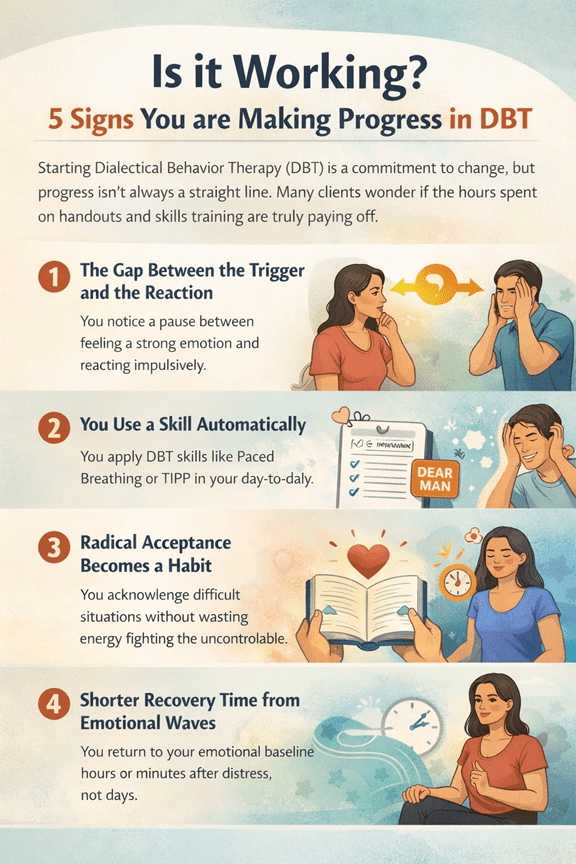
Is it Working? 5 Signs You are Making Progress in DBT
Starting Dialectical Behavior Therapy (DBT) is a commitment to change, but progress isn’t always a straight line. Many clients wonder if the hours spent on handouts and skills training are truly paying off. Success in DBT isn’t just about the absence of a crisis; it’s about the presence of new, skillful ways of living.
1. The Gap Between the Trigger and the Reaction
In the past, you might have reacted impulsively the moment you felt a strong emotion. Now, you notice a small “gap” where you can observe your feeling before acting on it. Even if you still feel the urge to react, the fact that you can stop for a split second to consider a skill is a major sign of Wise Mind development.
2. You Use a Skill Automatically
One of the clearest signs of progress is “Generalization”—when you use a DBT tool in your real life without being prompted by a therapist.
- You find yourself practicing Paced Breathing during a stressful work meeting.
- You use a DEAR MAN script to ask for what you need instead of shutting down.
- You splash cold water on your face (TIPP) when you feel a panic attack rising.
3. Radical Acceptance Becomes a Habit
Instead of fighting reality or asking “Why is this happening to me?”, you find yourself saying, “This is the situation I am in, and I have the tools to cope”. Radical Acceptance doesn’t mean you like what is happening; it means you’ve stopped wasting your energy on “fighting the uncontrollable,” allowing you to focus on problem-solving instead.
4. Shorter Recovery Time from Emotional Waves
You still experience intense emotions—that is part of being human. However, instead of an “Emotional Wave” lasting for days, it now lasts for hours or even minutes. You are able to return to your emotional baseline much faster than before because you are no longer fueling the fire with catastrophic thoughts.
5. Increased Self-Respect in Relationships
Progress in DBT often shows up in how you treat yourself and others. You might notice that you are keeping your commitments, setting healthy boundaries using FAST skills, and feeling less “effective-guilt” after social interactions. Your relationships become more stable as you learn to balance your needs with the needs of others.