
6 Conflict Resolution Skills Every Leader Needs
A Deep-Dive Guide With Scripts, Neuroscience, Conflict Styles, and DBT-Informed Skills
By Kelly Pinnick, DBT-Linehan Board of Certification, Certified Clinician | Southside DBT | Telehealth across Georgia
Every leader knows the feeling: two team members are not speaking. A meeting derails into defensiveness and blame. A long-simmering resentment finally surfaces at the worst possible moment. A relationship that was productive last month now feels charged and fragile.
Conflict is not a sign that something has gone wrong with your team. Research consistently shows that teams with no visible conflict often have the most dangerous dynamic of all: one where concerns go unspoken, dissent is suppressed, and problems compound in silence. The goal of conflict resolution is not to eliminate disagreement. It is to channel disagreement productively.
The six skills covered in this guide go far beyond what most leadership resources provide. We will cover each skill with depth, including the neuroscience behind why it works, real-world scripts you can use immediately, the specific conflict resolution styles and when each is appropriate, how to read the stage of escalation a conflict has reached, and the surprising connection between DBT, which is typically associated with mental health treatment, and the most evidence-supported approaches to managing human conflict at work.
Why Conflict Resolution Is a Leadership Skill, Not a Personality Trait
One of the most common mistakes leaders make about conflict is treating their ability to handle it as fixed: as something they are or are not naturally good at. Conflict resolution is not a temperament. It is a set of learnable, practicable skills that can be developed through understanding, deliberate practice, and honest reflection.
Research on workplace conflict consistently finds that unresolved conflict is among the most expensive organizational problems, both in direct costs such as turnover, absenteeism, and legal proceedings, and in indirect costs such as reduced productivity, eroded trust, and the loss of psychological safety that prevents teams from doing their best work.
Conversely, teams whose leaders have strong conflict resolution skills tend to have higher psychological safety, more innovation, better retention, and more honest upward communication. The leader’s capacity to handle conflict shapes not just individual relationships but the entire culture of how disagreement is treated within a team.
| Leaders who avoid conflict do not protect their teams from it. They transfer the cost of managing it to the team members themselves, who then carry it alone. |
The Neuroscience of Workplace Conflict
Understanding what is happening neurologically during conflict changes how you respond to it. The behaviors that make workplace conflict so difficult to resolve, defensiveness, emotional flooding, all-or-nothing thinking, inability to hear the other person’s perspective, are not character flaws. They are predictable products of a nervous system in perceived threat.
The Amygdala Hijack in Conflict
The amygdala is the brain’s threat detection center. In a conflict, particularly one that feels personal, involves perceived unfairness, or threatens a person’s status, competence, or belonging, the amygdala can fire a threat response before the prefrontal cortex has had time to evaluate the situation rationally. This is the amygdala hijack, a term coined by Daniel Goleman: the emotional brain takes over from the rational brain before the rational brain can intervene.
The result is the familiar set of unproductive conflict behaviors: escalated emotion, the inability to listen, saying things one later regrets, the sense of certainty about one’s own rightness, and the equally strong sense of the other person’s wrongness. These are not lapses in character. They are the predictable output of a threat-activated nervous system.
SCARF Model: The Social Threats That Activate Conflict
David Rock’s SCARF model identifies five domains of social threat and reward that are processed by the same neural circuits as physical threat and reward. Understanding these domains helps leaders anticipate what is driving conflict beneath its surface content.
| Domain | What It Means | How It Shows Up in Conflict | What Leaders Can Do |
| Status | Relative rank and importance | Person feels talked down to, undermined, or disrespected | Acknowledge contribution; avoid public criticism; frame as peer conversation |
| Certainty | Ability to predict the future | Ambiguity about outcomes, decisions, or roles escalates anxiety | Provide clarity on process and timeline even when outcome is uncertain |
| Autonomy | Sense of control over one’s situation | Micromanagement or removal of decision-making triggers resistance | Give choice within constraints; involve people in solving their own problems |
| Relatedness | Sense of safety with others | Perceived in-group/out-group dynamics inflame conflict | Build psychological safety; bridge between parties; demonstrate trust |
| Fairness | Perception of equitable exchanges | Perceived favoritism, inconsistent rules, or unequal burden escalates grievance | Make processes transparent; acknowledge when something was not equitable |
When a leader understands which SCARF domains are activated in a given conflict, they can address the real driver rather than only the surface content. A dispute about a project timeline may be primarily about autonomy. A complaint about credit may be primarily about status. Addressing the wrong domain will not resolve the conflict, no matter how skillfully it is handled.
The Five Conflict Styles — Knowing When to Use Each
The Thomas-Kilmann Conflict Mode Instrument identifies five distinct approaches to conflict, each defined by the balance between assertiveness, how much you pursue your own concerns, and cooperativeness, how much you accommodate the other person’s concerns. No style is universally right or wrong. The skill is knowing which style the situation calls for.
| Style | Approach | Best Used When | Risk If Overused |
| Competing | High assertiveness, low cooperativeness: I win, you lose | Safety is at stake; quick decision needed; you have positional authority and the stakes are high | Breeds resentment; shuts down input; team learns not to speak up |
| Avoiding | Low assertiveness, low cooperativeness: neither issue nor relationship addressed | Issue is trivial; timing is wrong; emotions are too high for productive conversation right now | Problems compound; unaddressed conflict festers; perceived as weak leadership |
| Accommodating | Low assertiveness, high cooperativeness: you win, I give in | Preserving the relationship matters more than the outcome; you recognize you are wrong | Your own needs go unmet; others may not respect your position; sets precedent of capitulation |
| Compromising | Moderate assertiveness and cooperativeness: we both give something | A good enough solution is needed quickly; a perfect resolution is not achievable | No one is fully satisfied; may not address root causes; can feel like splitting a difference rather than solving a problem |
| Collaborating | High assertiveness and high cooperativeness: we both win | The issue is important enough to justify the time; both parties need to commit to the outcome; creative solutions are possible | Time-intensive; inappropriate when quick decision is needed or power differential is too great |
| Key Insight | Most leaders default to one or two styles regardless of the situation. The conflict-competent leader chooses their style intentionally based on the stakes, the relationship, the urgency, and what is driving the conflict beneath the surface. |
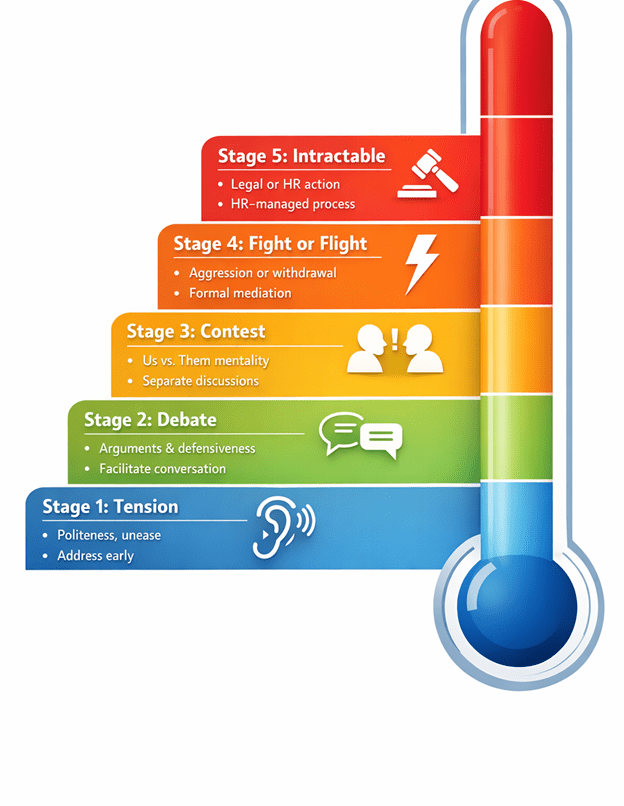
Conflict Escalation Stages — Matching Your Response to Where the Conflict Is
Different stages of conflict escalation require different responses. A response appropriate for Stage 1 will be insufficient for Stage 3, and a response calibrated for Stage 3 applied to Stage 1 will make things worse. Understanding the stage a conflict has reached is prerequisite to choosing the right intervention.
| Stage | Signs | Leader Action | What Will Not Work Here |
| Stage 1: Tension | People are polite but slightly stiff. Conversations feel careful. Minor irritations go unspoken. | Name it early: I want to check in because I sense something might be off. Early acknowledgment prevents escalation. | Ignoring it. Problems at Stage 1 are easiest and cheapest to address. |
| Stage 2: Debate | People argue their positions. Each side believes they are right. Listening decreases. Other issues get pulled into the discussion. | Facilitate a structured conversation. Use active listening. Separate positions from interests. What does each person actually need? | Taking sides. Trying to adjudicate who is right at the surface level. |
| Stage 3: Contest | Winning becomes more important than solving the problem. People seek allies. Information is withheld. Language becomes us versus them. | Separate the parties. Address each person individually before attempting joint conversation. Establish ground rules for any joint meeting. | Bringing both parties into the same room without preparation. Trying to find a compromise when trust is already significantly eroded. |
| Stage 4: Fight or Flight | People either become aggressive or disengage entirely. HR involvement may be needed. Relationships feel irreparable to the parties. | Formal process. Clear consequences. Professional mediation if needed. Focus shifts from resolution to safety and containment. | Informal coaching conversations. These will not be sufficient and may undermine formal process. |
| Stage 5: Intractable | Legal or HR action. One or both parties may need to exit. The relationship and possibly the team unit cannot be restored. | Organizational decision-making. Individual leadership conversations shift to HR-managed process. | Attempting further mediation without formal backing. |
The Six Conflict Resolution Skills — In Full
Each of the following skills is presented with what it actually is, why it matters at the neurological and relational level, what it sounds like in practice, and the evidence-based psychological framework that underpins it.
| Skill 1: Active Listening The most underrated skill in conflict — and the least practiced |
| What It Is: Active listening is not waiting for your turn to speak. It is the disciplined practice of attending fully to another person’s communication, including what is said, what is not said, and what is felt underneath the words, with the goal of understanding before responding. Why It Matters: When people feel genuinely heard, their amygdala threat response decreases. The brain’s reward circuits for social connection activate. Defensiveness reduces. The person becomes neurologically more capable of hearing a different perspective. Active listening is not a nicety. It is a neurochemical intervention. |
| What This Sounds Like in Practice: You have said that the timeline change felt like the decision was made without input from your team, and that this is not the first time something like this has happened. I want to make sure I understand: is it the specific timeline that concerns you most, or is it more about how the decision was made? |
| The DBT Skill Behind This: Mindfulness and Observe/Describe from DBT. The practice of attending to another person without judgment, noticing what is present without immediately reacting, is precisely what mindfulness trains. Leaders who practice mindfulness are measurably better active listeners. |
| Skill 2: Emotional Regulation Under Pressure The skill that determines whether the other five skills are accessible |
| What It Is: Emotional regulation in conflict means maintaining sufficient access to the prefrontal cortex even when the amygdala has been activated by a perceived threat. It is the ability to stay present, think clearly, and respond deliberately rather than react automatically when the conversation becomes charged. Why It Matters: This is the foundational skill because all other conflict resolution skills require prefrontal cortex access. A leader who has been flooded by their own emotional reaction cannot actively listen, cannot be empathic, cannot solve problems, and cannot facilitate neutral discussion. Managing your own emotional state is not about suppressing it. It is about keeping the window of tolerance open enough to function. |
| What This Sounds Like in Practice: I want to address this directly, and I also want to make sure I am hearing you accurately. Give me a moment to think about what you have said. I want to respond thoughtfully rather than reactively. |
| The DBT Skill Behind This: Distress Tolerance and Paced Breathing from DBT. TIPP skills reduce physiological arousal directly. Paced breathing, with a longer exhale than inhale, activates the parasympathetic nervous system and lowers emotional intensity within minutes. Leaders who use these skills in the moment of activation can stay regulated when the conversation is hardest. |
| Skill 3: Empathic Validation The bridge between positions and resolution |
| What It Is: Empathic validation means demonstrating genuine understanding of another person’s perspective and feelings, not necessarily agreement with their position, but authentic acknowledgment that their experience makes sense given who they are and what they have been through. Why It Matters: Validation activates the same social reward circuits as physical affirmation. It signals to the other person that they are safe with you, which reduces the threat response and opens access to collaborative thinking. People who feel validated are significantly more likely to move from entrenched positions toward genuine problem-solving. |
| What This Sounds Like in Practice: I hear that you felt cut out of a decision that directly affects your work, and that this matters because you care deeply about producing quality results. That makes complete sense. I would feel the same way if I were in your position. I want to understand how we got here so we can make sure it does not happen this way again. |
| The DBT Skill Behind This: Validation strategies from DBT. DBT’s validation framework identifies six levels of validation, from acknowledging attention to radical genuineness. Leaders who understand validation at this depth can meet people where they actually are rather than offering the surface-level acknowledgment that often makes things worse. |
| Skill 4: Neutral Facilitation Creating the conditions for others to resolve conflict themselves |
| What It Is: Neutral facilitation is the skill of creating a structured, safe container for two or more parties to address a conflict directly, without the leader directing the outcome, taking sides, or substituting their judgment for the parties’ own resolution. Why It Matters: When a leader adjudicates a conflict, the winner and loser may be determined, but neither party has learned the relational skills to handle future conflict, and the loser carries resentment. When a leader facilitates resolution between parties, the resolution is theirs, the learning is theirs, and the relationship is stronger for it. |
| What This Sounds Like in Practice: I have asked you both here because I have noticed tension that is affecting our team’s work, and I want to give you a space to address it directly. I am going to create the space for this conversation, but I am not going to tell you what to do or who is right. My role is to help you hear each other and find a path forward together. Who wants to start? |
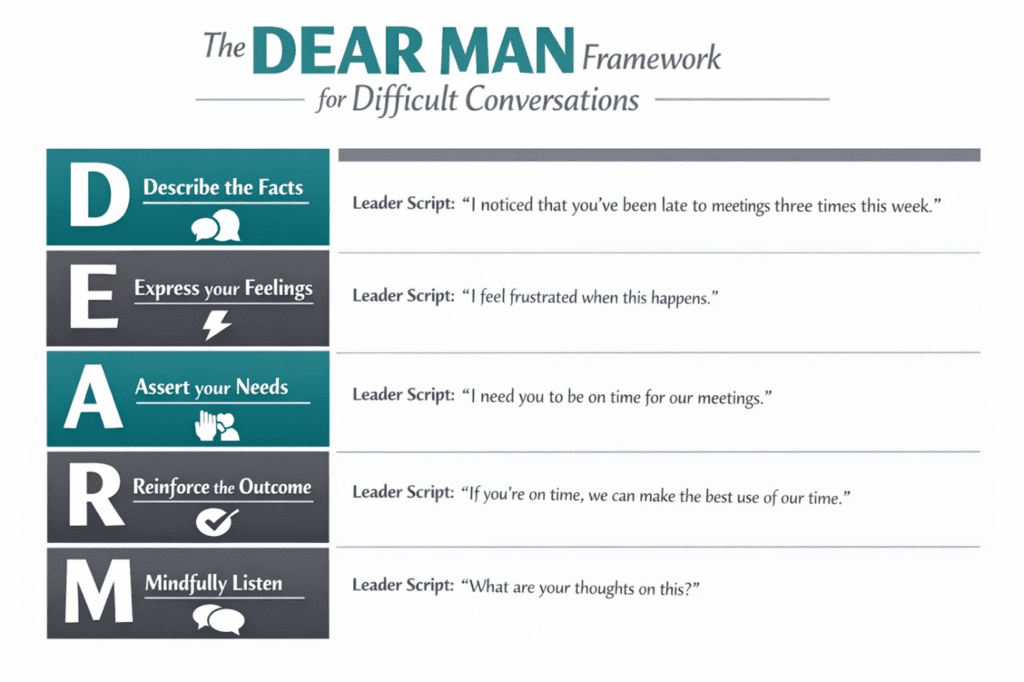
| The DBT Skill Behind This: Interpersonal Effectiveness from DBT. DEAR MAN and GIVE skills provide structure for communicating needs and maintaining the relationship simultaneously. Leaders can teach these frameworks to team members directly as tools for their own conflict conversations. |
| Skill 5: Separating Positions from Interests The skill that finds the solution everyone missed |
| What It Is: Positions are what people say they want. Interests are why they want it. Two people in conflict often have incompatible positions and completely compatible interests. Finding the resolution requires moving from position to interest. Why It Matters: This distinction comes from Fisher and Ury’s Getting to Yes and is one of the most clinically validated concepts in negotiation and conflict resolution. Most unresolved conflicts are stuck at the position level because neither party has been asked or has asked themselves what they actually need underneath what they are demanding. |
| What This Sounds Like in Practice: You are both saying you want to be the lead on the client account, and I hear that clearly. I want to step back from that for a moment. Marcus, what is most important to you about leading this account specifically? And Janelle, what does leading this account mean to you? I want to understand what success looks like for each of you so we can figure out what we are actually trying to solve. |
| The DBT Skill Behind This: Check the Facts and Wise Mind from DBT. Checking the facts distinguishes what is actually happening from interpretation. Wise Mind holds emotional needs and rational analysis simultaneously, which is exactly what separating positions from interests requires. |
| Skill 6: Repair and Follow-Through The skill everyone forgets — and the one that determines whether resolution lasts |
| What It Is: Repair is the set of actions taken after a conflict is addressed to restore the relationship, confirm that agreements are holding, and acknowledge the effort all parties made to work through something difficult. Follow-through converts conversation into demonstrated behavior change. Why It Matters: Without repair, resolved conflicts often re-ignite. The brain’s social threat circuits continue to monitor for evidence of the previous threat. Explicit repair signals, words and actions that confirm the relationship is safe and the resolution was genuine, are needed to down-regulate this monitoring. Research on interpersonal relationships consistently shows that repair skill is a stronger predictor of relationship quality than conflict frequency. |
| What This Sounds Like in Practice: I wanted to follow up on our conversation from Tuesday. I know that was not an easy discussion. I wanted to tell you that I have taken what you said seriously, and I want you to know that the changes we talked about are going to happen. And I want to check in: how are you feeling about where things stand now? |
| The DBT Skill Behind This: Opposite Action and Accumulating Positive Experiences from DBT. Deliberately investing in the relationship after conflict is opposite to the avoidance urge that often follows hard conversations. Building positive experiences together creates the relational bank account that makes future conflict less destabilizing. |
Conflict Resolution Scripts for Specific Situations
Scripts are not formulas to follow rigidly. They are starting structures that reduce the cognitive load of a difficult conversation enough to keep the prefrontal cortex online when the amygdala would prefer to take over. Use them as starting points, not scripts to read verbatim.
Opening a Conflict Conversation
The purpose: Establish safety, name the purpose of the conversation, and signal that you are coming as a partner rather than a judge.
I want to talk about something I have been noticing, and I want to make sure I am understanding the situation correctly before anything else. This is not a performance conversation and it is not disciplinary. I value your work and this relationship, and I want us to be able to address this directly together. Is now a good time to talk?
De-escalating Defensiveness Mid-Conversation
The purpose: Interrupt the escalation spiral before both parties flood and the conversation becomes unproductive.
I want to pause for a second because I can feel this conversation getting heated, and I think that if we keep going like this we are going to say things that are not actually useful. I am not going anywhere. This matters enough to me to slow down and do it right. Can we both take a breath and come back to this?
Facilitating Between Two Team Members
The purpose: Create neutral ground, establish listening as the first task, and prevent the conversation from becoming a competition.
I am going to ask each of you to do something genuinely hard: to listen to the other person without planning your response while they are speaking. When one person is talking, the other person’s job is only to understand, not to agree or disagree. After each person speaks, I am going to ask the listener to say back what they heard. We will start with that before we try to solve anything.
Addressing a Long-Standing Conflict That Has Not Been Named
The purpose: Name the pattern without attributing blame, and signal that you see what others may have been reluctant to say.
I want to be direct with you about something I have been observing for a while, because I think not naming it has actually made it harder for both of us to work well together. I am not here to assign blame. I am here because I think we have something between us that has been affecting our work, and I believe that naming it directly is better for both of us than continuing to work around it.
Conflict Resolution in Special Contexts
Remote and Hybrid Teams
Remote and hybrid environments create specific conflict risks that in-person teams do not face with the same frequency. Misinterpretation of written communication, absence of the relational warmth that in-person proximity creates naturally, unequal visibility between remote and in-person employees, and time zone differences that create inequitable access to decision-making all generate conflict that is harder to detect and address remotely.
For remote conflict resolution, leaders should default to video conversations over written communication for any conflict-adjacent discussion. Written communication strips tone and facial expression, which are two of the primary channels through which empathy and validation are communicated. If a written exchange begins to escalate, moving to video should happen earlier than feels natural.
Cross-Cultural Conflict
Different cultural backgrounds carry different assumptions about appropriate emotional expression, directness, hierarchy, and individual versus collective goals. What reads as passive aggression in one cultural context reads as appropriate respect in another. What reads as appropriate directness in one context reads as disrespectful aggression in another.
Leaders navigating cross-cultural conflict should increase their curiosity about interpretation before drawing conclusions. The question is not whether a behavior was problematic, but what it meant in the context of the person who produced it, and what it meant to the person who received it. Both answers are necessary.
Conflict Involving Power Differentials
Conflict between a supervisor and direct report is categorically different from conflict between peers. The power differential shapes what each party can safely say, how much genuine resolution is possible without formal process, and what repair looks like afterward. Leaders in supervisory roles should be particularly attuned to the risk of their own positional power silencing the honest communication that resolution requires.
Creating psychological safety for a direct report to speak honestly about a conflict with you requires explicit permission, demonstrated through consistent non-punitive responses to honest feedback over time, rather than simply asking for it.
Why DBT Skills Make Better Conflict Resolvers
DBT was developed as a clinical treatment for severe emotion dysregulation, primarily associated with borderline personality disorder. It may seem distant from a leadership context. It is not.
The skills DBT teaches, tolerating distress without reactive behavior, regulating emotional intensity, validating others’ experiences, communicating needs and limits effectively, and finding the middle path between capitulation and aggression, are precisely the skills that conflict resolution research identifies as the most important and the most difficult to maintain under pressure.
Leaders who struggle with conflict resolution almost always struggle specifically with one of the following: their own emotional reactivity in the moment of activation, the discomfort of sitting with unresolved tension, or the difficulty of holding their own position while genuinely hearing someone else’s. DBT addresses all three.
| Conflict Resolution Challenge | DBT Skill That Addresses It |
| Flooding when conflict gets personal | Paced Breathing and Temperature from TIPP: physiological down-regulation |
| Saying things you regret when activated | Observe before Act: creating the space between stimulus and response |
| Difficulty hearing the other person’s perspective | Mindfulness of Others: attending fully without judgment |
| Validating without caving on your position | Dialectical thinking: both things can be true simultaneously |
| Communicating needs without aggression or passivity | DEAR MAN: Describe, Express, Assert, Reinforce, Mindful, Appear confident, Negotiate |
| Maintaining the relationship while setting a limit | GIVE: Gentle, Interested, Validate, Easy manner alongside assertion |
| Tolerating the discomfort of unresolved conflict | Radical Acceptance: accepting what cannot immediately be changed without fighting it |
| Recovering after a difficult conflict conversation | Opposite Action for shame or avoidance: proactive repair instead of withdrawal |
Leaders who are personally working through their own emotional regulation challenges, whether in a clinical context or through skill development, often find that the same growth that changes their personal relationships changes how they lead through conflict. The interpersonal effectiveness skills in DBT were designed for human relationships. Leadership relationships are a subset of those.
| At Southside DBT | Kelly Pinnick works with clients on exactly these interpersonal effectiveness skills. Whether in a personal or professional context, the ability to communicate needs, validate others, maintain positions under emotional pressure, and repair after conflict are learnable skills that change the texture of every relationship, including the ones at work. |
Summary: The Leader’s Conflict Resolution Framework
Conflict resolution competence in leadership rests on four foundations:
- Self-awareness: knowing your own conflict style, your SCARF triggers, and your emotional regulation patterns under pressure
- Situational reading: accurately assessing the stage of conflict escalation and which SCARF domains are activated
- Skill selection: choosing the right approach for the situation rather than defaulting to the same response regardless of context
- Consistent follow-through: doing the repair work that transforms resolved conflict into strengthened relationships
The six skills, active listening, emotional regulation, empathic validation, neutral facilitation, separating positions from interests, and repair, are not techniques to deploy sequentially. They are capacities to develop and draw from, choosing the one or ones that the moment requires. And like all capacities, they develop through practice, honest reflection, and occasionally through seeking support from people trained to help with exactly this kind of growth.
| Working on Interpersonal Effectiveness and Emotional Regulation? Southside DBT provides comprehensive DBT treatment that builds the interpersonal effectiveness, emotional regulation, and distress tolerance skills that improve every relationship, including those at work. Kelly Pinnick | DBT-Linehan Board of Certification, Certified Clinician | Telehealth across Georgia (770) 880-2538 | kelly@southsidedbt.com Accepting: Aetna | Anthem BCBS GA | Cigna | United Healthcare | Self-Pay $150/session |