How Long Does Gabapentin Take to Work?
A Complete, Condition-by-Condition Guide to Timelines, Side Effects, and What to Expect
By Kelly Pinnick, DBT-Linehan Board of Certification, Certified Clinician | Southside DBT | Telehealth across Georgia
| Medical Disclaimer: This guide is for educational purposes only and does not constitute medical advice. Never start, stop, or adjust gabapentin without guidance from your prescribing physician or pharmacist. Gabapentin has significant interactions and discontinuation risks. |
If you have just been prescribed gabapentin, or you are considering it, the most pressing question is usually simple: when will I actually feel better?
The honest answer depends on what you are taking it for. Gabapentin behaves quite differently across its various uses, reaching therapeutic effect within hours for acute pain and nerve calming, while requiring weeks of consistent dosing for anxiety, mood stabilization, or seizure control. That range, hours to weeks, is where most of the confusion lies.
This guide answers the timeline question condition by condition, explains how gabapentin works neurologically so the timeline makes sense, covers the side effect profile with the detail it deserves, and addresses the questions most people have that generic articles skip: dosage titration, what happens if it stops working, the real risk profile around dependence and withdrawal, and how gabapentin fits alongside therapy for mental health conditions.
Part 1: What Is Gabapentin?
Gabapentin, sold under brand names including Neurontin, Gralise, and Horizant, is an anticonvulsant and nerve pain medication that was originally developed to treat epilepsy. It received FDA approval in 1993 for seizure control as an add-on treatment for partial seizures.
Since then, its use has expanded considerably. It is FDA-approved for postherpetic neuralgia, a painful nerve condition that can follow shingles. It is also prescribed extensively off-label for a wide range of conditions including neuropathic pain from various causes, anxiety disorders, bipolar disorder, alcohol and opioid withdrawal management, restless leg syndrome, hot flashes, and chronic pain syndromes.
Gabapentin is one of the most prescribed medications in the United States, with tens of millions of prescriptions written annually. Its widespread use reflects its versatility, but it also means that many people are taking it for conditions where the evidence base is thinner than for its approved uses, and where the expected timeline and outcome may be less predictable.
Part 2: How Gabapentin Works — The Neuroscience
Despite its name, gabapentin does not actually work like a gamma-aminobutyric acid, or GABA, compound in the brain. This is a common misconception driven by the name. Gabapentin does not bind to GABA receptors and does not increase GABA concentrations in any direct way.
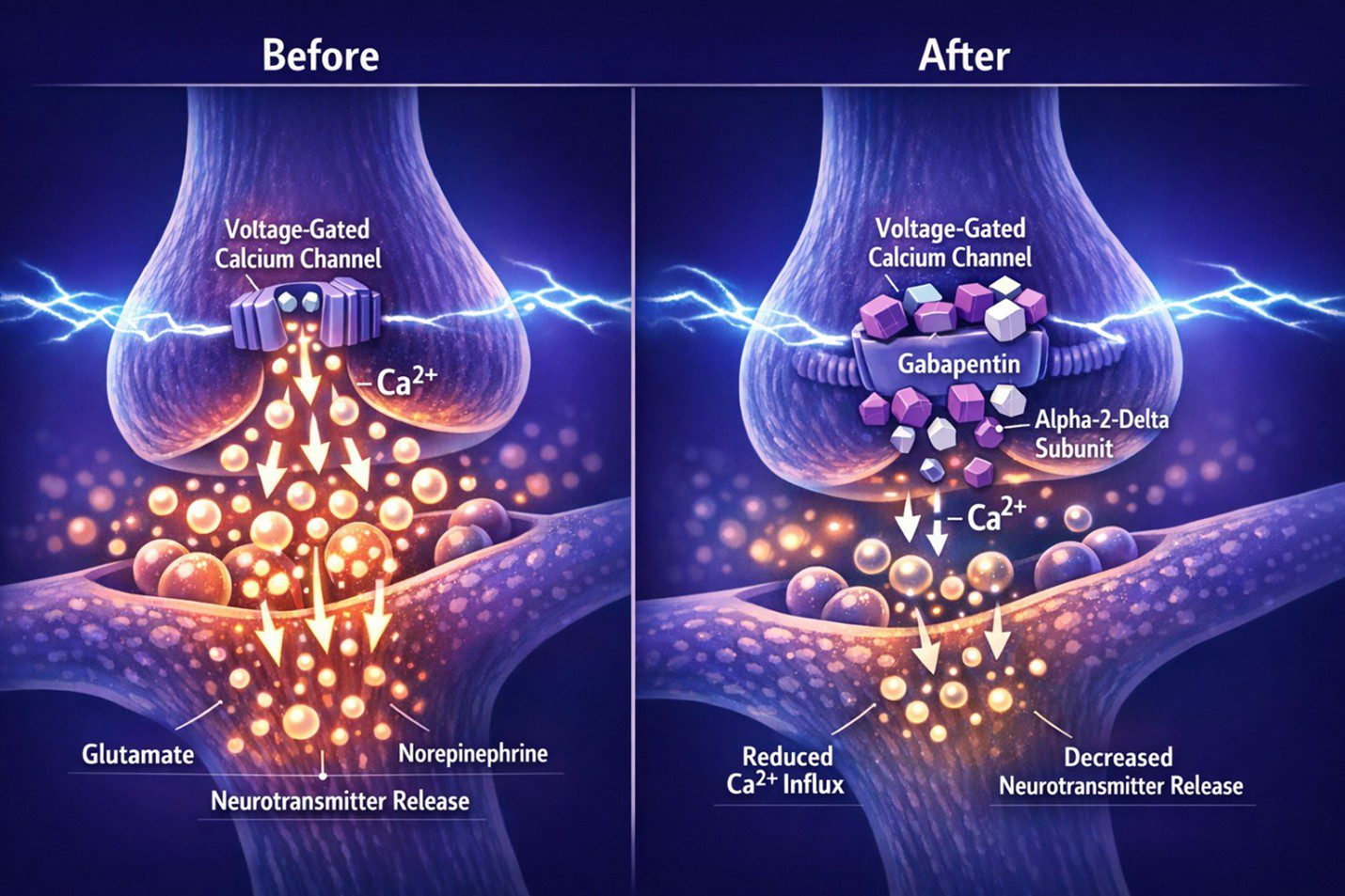
Instead, gabapentin works primarily by binding to the alpha-2-delta subunit of voltage-gated calcium channels in neurons. These channels regulate the release of neurotransmitters involved in pain signaling and neural excitability. By binding to this subunit, gabapentin reduces the influx of calcium into neurons, which in turn reduces the release of excitatory neurotransmitters including glutamate, norepinephrine, and substance P.
The clinical result is a reduction in neural hyperexcitability. In seizure conditions, this reduces the likelihood of excessive electrical firing. In neuropathic pain, it dampens the amplified pain signals that characterize nerve damage. In anxiety, it reduces the heightened neural arousal that drives anxious states.
| Gabapentin calms an overactive nervous system. It does not work immediately for most conditions because the binding and downstream effects require time to accumulate to therapeutic levels. This is why patience and consistent dosing matter. |
Why the Timeline Varies So Much Across Conditions
The variation in gabapentin’s timeline is directly explained by its mechanism. For acute pain relief, particularly when administered in higher single doses before or after surgery, the calcium channel effect begins within one to two hours and provides meaningful pain reduction. This is the fastest-acting presentation of gabapentin’s effects.
For chronic neuropathic pain, the effect requires sustained receptor binding across multiple doses. As gabapentin accumulates in the system through consistent dosing, the reduction in pain signaling deepens. This typically takes one to two weeks to become clinically noticeable.
For psychiatric applications such as anxiety or mood stabilization, the timeline is longer still. These effects appear to involve not just the acute calcium channel effects but also downstream changes in neurotransmitter dynamics and neural network activity that develop over weeks of steady-state dosing.
Part 3: How Long Does Gabapentin Take to Work — By Condition
This is the most practically useful section of this guide. Below is a comprehensive breakdown of the expected timeline for each condition gabapentin is used to treat.
| Condition | Initial Relief | Full Effect | Key Notes |
| Acute postoperative pain | 1 to 2 hours | Same dose | Single pre/post-surgical dose. Used for acute pain control, not chronic management. |
| Postherpetic neuralgia | 3 to 7 days | 2 to 4 weeks | FDA-approved use. Pain reduction is gradual and dose-dependent. |
| Diabetic neuropathy | 1 to 2 weeks | 4 to 6 weeks | Off-label. Most evidence for partial pain reduction rather than complete relief. |
| Generalized anxiety disorder | Hours (partial) to 1 week | 2 to 4 weeks | Off-label. Calming effect may be felt quickly; full anxiolytic effect takes weeks. |
| Epilepsy / seizure control | Several days | Several weeks | FDA-approved as adjunctive therapy. Requires therapeutic blood levels. |
| Alcohol withdrawal | Hours | Acute use only | Used for acute management. Not a long-term treatment for alcohol use disorder. |
| Restless leg syndrome | 1 to 3 days | 1 to 2 weeks | Horizant formulation specifically studied. Notable improvement in sleep. |
| Fibromyalgia / chronic pain | 1 to 2 weeks | 4 to 8 weeks | Off-label. Evidence is mixed. Response varies considerably across individuals. |
| Bipolar disorder | 1 to 2 weeks | 4 to 6 weeks | Off-label. Used as adjunct, not first-line. Evidence limited compared to approved mood stabilizers. |
| PTSD-related symptoms | 1 to 2 weeks | 3 to 6 weeks | Off-label. Some evidence for hyperarousal and sleep symptoms. |
| Hot flashes (menopausal) | 1 to 2 weeks | 3 to 4 weeks | Off-label. Some evidence for reduction in frequency and severity. |
| Opioid withdrawal | Hours to 1 day | Acute use 5 to 10 days | Used to manage acute withdrawal symptoms. Requires medical supervision. |
| Important Context | The timelines above represent averages from clinical research. Your individual timeline may be shorter or longer depending on your dose, kidney function, metabolism, body weight, and how your nervous system responds to the medication. Always discuss your specific situation with your prescriber. |
Part 4: Factors That Affect How Long Gabapentin Takes to Work
Understanding what influences your individual timeline helps set realistic expectations and informs conversations with your prescriber.
Dosage and Dose Escalation
Gabapentin is almost always started at a low dose and titrated upward, meaning gradually increased over days to weeks. This approach minimizes side effects but also means that the therapeutic dose is not reached immediately. Most people are not on their full therapeutic dose from day one.
For anxiety, therapeutic doses in research range from 600 to 3,600 mg per day, typically divided into two to three doses. For neuropathic pain, doses of 1,800 to 3,600 mg per day are common in clinical practice. If you are currently on a low starting dose, the timeline to effect begins when you reach a sufficient therapeutic dose, not from the first day of taking any amount.
Kidney Function
This is one of the most clinically important and least discussed factors affecting gabapentin’s timeline. Gabapentin is eliminated almost entirely by the kidneys. In people with reduced kidney function, gabapentin accumulates in the body at higher concentrations and may reach therapeutic effect at lower doses and faster timelines, but it also carries greater risk of side effects including sedation and cognitive effects.
Older adults, who commonly have some degree of age-related kidney function decline, require particular attention here. Standard adult doses can produce significantly higher blood levels in elderly patients, and what appears to be a therapeutic dose based on standard guidelines may be an excessive dose for someone with reduced kidney clearance.
Metabolism and Body Weight
Unlike many psychiatric medications, gabapentin is not metabolized by liver enzymes and does not interact with the cytochrome P450 system. This is actually a clinical advantage in some respects, as it reduces the drug-drug interactions that complicate many other medications. However, body weight and the rate of kidney clearance still affect how quickly gabapentin reaches stable blood levels and how much accumulates per dose.
Consistency of Dosing
Gabapentin has a relatively short half-life of five to seven hours in adults with normal kidney function. This means it leaves the body fairly quickly, and missing doses or taking them irregularly prevents stable blood levels from being maintained. Consistent, evenly spaced dosing is more important for gabapentin than for some medications with longer half-lives. If you are taking gabapentin three times daily and frequently miss the middle dose, your therapeutic blood levels will be substantially lower than they would be with consistent dosing.
Co-Occurring Conditions and Medications
The presence of other medical or psychiatric conditions affects both gabapentin’s timeline and its effect. People with severe anxiety may require higher doses before a meaningful reduction in symptoms is noticeable. People with comorbid depression alongside anxiety may find that gabapentin addresses some features of their presentation while others persist and require separate treatment.
Several medications interact with gabapentin in ways that affect its action. Antacids containing aluminum and magnesium can reduce gabapentin absorption by up to twenty percent when taken simultaneously. Opioids and gabapentin together produce additive central nervous system depression that can be dangerous. Alcohol significantly amplifies gabapentin’s sedative effects. These interactions can affect both the timeline and the safety of gabapentin treatment.
Part 5: Gabapentin Side Effects — A Complete Breakdown
Talkspace’s article on this topic contains no side effect information whatsoever. This is a significant gap. Side effects are one of the primary reasons people want to understand gabapentin better, and managing them intelligently requires knowing what to expect and when.
| Side Effect | Frequency | When It Occurs | Management |
| Drowsiness and sedation | Very Common | First days to weeks | Take at bedtime if possible. Reduce dose if impairing. Usually improves with time. |
| Dizziness and unsteadiness | Very Common | First days to weeks | Rise slowly from sitting. Avoid driving until effect is known. Usually improves. |
| Cognitive slowing and mental fog | Common | Ongoing at higher doses | Dose reduction or splitting doses differently may help. Discuss with prescriber. |
| Fatigue | Common | First weeks | Often improves. Morning dosing adjustments may help. |
| Weight gain and increased appetite | Common | Weeks to months | Monitor weight. Physical activity and dietary awareness recommended. |
| Peripheral edema (swelling of feet/ankles) | Common | Weeks to months | Report to prescriber. May require dose adjustment or medication change. |
| Nausea and gastrointestinal upset | Common | Usually early treatment | Take with food. Usually resolves within first two weeks. |
| Visual disturbances (blurred or double vision) | Common | At higher doses | Report if persistent or severe. Usually dose-dependent. |
| Mood changes, irritability, or depression | Less Common | Variable | Report to prescriber promptly. Important for mental health monitoring. |
| Suicidal ideation (FDA black box warning) | Rare | Any time during treatment | Seek emergency help immediately. Monitor mood carefully especially early in treatment. |
| Respiratory depression (with opioids or alcohol) | Rare but serious | With co-administration | Avoid combining with opioids or alcohol. Potentially life-threatening. |
| Memory impairment | Less Common | Ongoing at higher doses | May improve with dose reduction. Discuss if affecting daily function. |
| FDA Black Box Warning: Antiepileptic drugs including gabapentin carry an FDA black box warning for increased risk of suicidal thoughts and behavior. Monitor for new or worsening depression, anxiety, agitation, panic attacks, or suicidal thinking, particularly in the first weeks of treatment or after dose changes. Report any such changes to your prescriber immediately. |
Side Effects in Elderly Patients
Older adults are significantly more vulnerable to gabapentin side effects, particularly sedation, dizziness, cognitive impairment, and fall risk. As noted in Part 4, reduced kidney function in older adults leads to gabapentin accumulation at standard doses. Falls related to gabapentin-induced dizziness and unsteadiness are a clinically significant concern in this population.
Starting doses in elderly patients should be substantially lower than standard adult doses, and titration should proceed more slowly. Any dizziness or cognitive changes in an older adult taking gabapentin should be reported to the prescriber promptly.
Part 6: Dosage and Titration — Why Patience Is Built Into the Process
One of the most important things to understand about gabapentin is that the titration process, the gradual dose escalation, is not cautious timidity on your prescriber’s part. It is a clinical necessity that serves two purposes: it allows your nervous system to adapt gradually to the medication’s effects, and it identifies your optimal dose without producing excessive side effects.
Typical Titration Schedules
For anxiety and off-label psychiatric use, a common starting approach is 300 mg at bedtime for three to five days, then 300 mg twice daily, then 300 mg three times daily, with further increases as needed and tolerated. Some prescribers start even lower, at 100 mg, for patients who are particularly sensitive to medications.
For neuropathic pain, titration typically moves more quickly, with a standard approach reaching 900 mg per day within the first week and then increasing toward 1,800 to 3,600 mg per day as needed and tolerated.
The ceiling dose is typically 3,600 mg per day in divided doses for most indications, though some clinical protocols use higher doses in selected patients. Doses above this threshold have not been shown to produce additional therapeutic benefit and increase side effect burden.
The Titration-Timeline Relationship
Because of titration, the true answer to how long gabapentin takes to work involves two separate timelines. The first is how long it takes to reach your therapeutic dose. The second is how long it takes to feel the full effect once you are at that dose.
For someone being titrated slowly to 1,800 mg per day, they may not reach their therapeutic dose for three to four weeks. The full effect may then take another two to four weeks on top of that. This means the realistic timeline from first pill to full effect for anxiety could be six to eight weeks or more, not the one month Talkspace’s article mentions.
Part 7: Signs That Gabapentin Is Working
Improvement with gabapentin is often gradual rather than sudden, and it can be easy to miss. Keeping a symptom journal is genuinely useful for tracking progress that might not be obvious day to day but becomes clear week to week.
For Neuropathic Pain
- Burning, shooting, or electric shock sensations are less frequent or less intense
- Baseline pain level between episodes has decreased
- Sleep is less disrupted by pain
- Physical tolerance for daily activities has increased
- Less reliance on additional pain relievers for breakthrough pain
For Anxiety
- Physical symptoms of anxiety, racing heart, muscle tension, rapid breathing, feel less intense or less frequent
- The baseline level of worry feels reduced even if triggers are still present
- Sleep quality has improved, particularly getting to sleep and staying asleep
- Social situations or previously anxiety-provoking events feel more manageable
- You feel less on edge or hypervigilant in general
For Seizure Control
- Reduction in seizure frequency, which requires tracking and clinical confirmation
- If breakthrough seizures occur, they may be less severe or shorter
- EEG monitoring by your neurologist confirms reduction in epileptiform activity
For Mood and PTSD Symptoms
- Hyperarousal and startle responses feel less intense
- Sleep disturbance related to nightmares or difficulty staying asleep has reduced
- Emotional reactivity and irritability feel more manageable
- Overall mood stability has improved
Part 8: What to Do When Gabapentin Is Not Working
If gabapentin is not producing the expected effect, the conversation with your prescriber should cover several specific questions.
Has the Therapeutic Dose Been Reached?
This is the first question to ask. If you are still on a starting or intermediate dose, the lack of effect may simply reflect insufficient dosing rather than a lack of response. Do not conclude that gabapentin does not work for you until you have been at a full therapeutic dose for a sufficient period.
Has Enough Time Passed?
For anxiety and chronic pain, four to eight weeks at therapeutic dose is a more realistic timeline for assessing full effect than the one-month figure that is often cited. If you are at week three of a slow titration, you may not yet be at either the right dose or the right timeframe.
Are Side Effects Limiting the Dose?
Some people experience side effects that prevent adequate dose escalation. If sedation or cognitive effects are significant at the dose needed for effect, this is a clinical problem that needs addressing. Options include: splitting the dose differently across the day, taking more of the dose at bedtime, using extended-release formulations, or considering gabapentin alternatives such as pregabalin.
Is There a Drug Interaction Reducing Absorption?
If you are taking antacids containing magnesium or aluminum hydroxide, timing matters. These reduce gabapentin absorption by up to twenty percent when taken simultaneously. Taking gabapentin at least two hours before or after antacids resolves this interaction.
Is the Condition Requiring a Different Approach?
For some conditions, gabapentin is not a sufficiently potent treatment, or the clinical picture requires an additional or different intervention. This is particularly true for anxiety disorders, where the evidence base for gabapentin is real but weaker than for SSRIs and SNRIs, and for mood disorders where gabapentin is an adjunct rather than a primary treatment. Honest discussion with your prescriber about whether gabapentin alone is the right strategy is appropriate if improvement has been minimal after a genuine trial.
Part 9: Gabapentin vs Pregabalin — Key Differences
Pregabalin, sold as Lyrica, is a close relative of gabapentin that works through the same mechanism. Understanding the differences helps explain why some people switch from one to the other.
| Feature | Gabapentin | Pregabalin (Lyrica) |
| Absorption | Non-linear: higher doses absorbed less efficiently | Linear: predictable absorption at all doses |
| Onset of effect | Slower; several days to weeks for most conditions | Faster; often 1 week for anxiety and pain |
| Dosing frequency | Typically 3 times daily required | Typically 2 times daily sufficient |
| FDA-approved uses | Epilepsy, postherpetic neuralgia | Neuropathic pain, fibromyalgia, GAD, epilepsy |
| Schedule | Not federally scheduled (some states schedule it) | Schedule V controlled substance |
| Cost | Generic available; often inexpensive | Generic available; historically more expensive |
| Side effect profile | Similar: sedation, dizziness, weight gain | Similar but may be more pronounced at equivalent effect |
Part 10: Gabapentin Safety, Dependence, and Withdrawal
This section addresses the questions that most gabapentin guides either skip or handle superficially, often because the answers are uncomfortable for platforms that prescribe the medication.
Dependence and Misuse
Gabapentin was initially considered to have low abuse potential, and this contributed to it not being federally scheduled as a controlled substance. That assessment has been significantly revised.
Research over the past decade has documented that gabapentin has real dependence potential, particularly at higher doses and with regular use. Misuse of gabapentin, defined as use outside of prescribed parameters, is documented at rates of 15 to 22 percent in patients prescribed it, and substantially higher in populations with substance use histories.
Gabapentin is particularly dangerous when combined with opioids. A substantial body of evidence now links gabapentin-opioid combinations to overdose deaths, and multiple states have rescheduled gabapentin as a controlled substance in response. If you have a history of substance use disorder, particularly opioid use disorder, this risk profile must be explicitly discussed with your prescriber.
Physical Dependence and Withdrawal
With regular use, particularly at higher doses, gabapentin produces physical dependence. This means the body adapts to its presence, and stopping abruptly or reducing too quickly can produce withdrawal symptoms.
Gabapentin withdrawal symptoms can include:
- Anxiety, agitation, and restlessness
- Insomnia and sleep disturbance
- Nausea and gastrointestinal upset
- Sweating and tremor
- In severe cases, seizures
| Never stop gabapentin abruptly. Abrupt discontinuation after regular use can trigger withdrawal, including seizures, even in people who do not have a history of epilepsy. Gabapentin must be tapered gradually under medical supervision. This is non-negotiable. |
The duration of use, dose, and individual factors all affect withdrawal severity. People who have been taking gabapentin for weeks or months require a longer, more gradual taper than people who have been on it for a few days. Your prescriber should provide a specific tapering schedule if you are discontinuing.
Part 11: Gabapentin, Mental Health, and the Role of Therapy
For people taking gabapentin for anxiety, PTSD-related symptoms, mood instability, or pain that is significantly affecting their mental health, medication is rarely the complete answer. This is not a limitation of gabapentin specifically. It reflects the broader reality that mental health conditions with complex behavioral, cognitive, and relational dimensions require more than neurochemical management alone.
What Gabapentin Can and Cannot Do for Mental Health
Gabapentin can reduce the physiological hyperarousal that amplifies anxiety. It can improve sleep disrupted by pain or anxiety. It can lower the baseline level of nervous system activation that makes everything feel overwhelming. These are meaningful and genuine contributions.
What gabapentin cannot do is change how you interpret threatening situations, build your capacity to tolerate distress, repair relationships affected by emotional dysregulation, or address the behavioral patterns that maintain anxiety or mood instability. These require active therapeutic work.
DBT and Gabapentin for Anxiety and Emotional Dysregulation
For people whose anxiety or mood symptoms are embedded in broader patterns of emotion dysregulation, DBT offers a complementary approach to medication. The DBT distress tolerance skills provide practical tools for managing the moments of acute distress that gabapentin reduces but does not eliminate. The emotion regulation module addresses the patterns of emotional reactivity that persist between acute episodes. Mindfulness skills support the calmer baseline that gabapentin helps create.
In clinical practice, medication and therapy work best together. Gabapentin can lower the floor of anxiety enough to make therapeutic work accessible. The therapeutic work then addresses dimensions of the problem that medication alone cannot reach.
| At Southside DBT | Kelly Pinnick works with clients who are managing anxiety, PTSD, BPD, and mood-related conditions, often alongside psychiatric medication. DBT skills complement medication management by building the behavioral and regulatory capacity that allows clients to use the calmer baseline medication provides as a foundation for genuine change. |
Summary: Key Things to Remember About Gabapentin’s Timeline
- The timeline depends on what you are treating. Acute pain: hours. Chronic neuropathic pain: one to two weeks to start, four to six weeks for full effect. Anxiety: one week for initial calming, two to four weeks for full effect at therapeutic dose.
- You may not be at your therapeutic dose yet. Titration means the full timeline starts when you reach the right dose, not when you take the first pill.
- Kidney function significantly affects how gabapentin behaves in your body. Elderly patients and anyone with kidney impairment need careful monitoring.
- Side effects are common early in treatment and often improve. Sedation and dizziness typically reduce within two to three weeks as your body adjusts.
- Never stop abruptly. Gabapentin withdrawal can be serious and must be tapered under medical supervision.
- Gabapentin combined with opioids or alcohol carries significant respiratory depression risk. This combination should be avoided.
- For mental health applications, medication works best alongside appropriate therapy. Gabapentin can provide a calmer baseline. Therapy addresses what medication cannot.
| Managing Anxiety, PTSD, or Emotional Dysregulation in Georgia? Southside DBT provides evidence-based DBT treatment that complements medication management for anxiety, PTSD, BPD, and mood-related conditions via telehealth across Georgia. Kelly Pinnick | DBT-Linehan Board of Certification, Certified Clinician (770) 880-2538 | kelly@southsidedbt.com Accepting: Aetna | Anthem BCBS GA | Cigna | United Healthcare | Self-Pay $150/session |